Liberty or Equality is a book of approximately 280 pages, written in 1952 by Erik Maria Ritter-Von Kuehnelt Leddihn. He was an Austrian knight and a polyglot who spoke eight languages, and read eleven more. Born in 1909 and having grown up in Lans (Tirol), he witnessed the collapse of the Austro-Hungarian Monarchy and the subsequent rise of democracy after the first World War. And not much later, he witnessed the collapse of the Weimar Republic and the rise of Nazism. These events taken together made him an immense sceptic of democracy, and in particular of mass movements/ideologies. He was a teacher in the United States between 1937 and 1947 (https://habsburgottoalapitvany.hu/en/a-reactionary-liberal-knight-of-the-20th-century/).
As a close friend of Friedrich von Hayek and Ludwig von Mises, he was member of the Mises Institute (https://mises.org/profile/erik-von-kuehnelt-leddihn). In that capacity, he wrote the book Liberty or Equality, released in 1952, which heavily criticises democracy. More than a critique of democracy as such, the question is, what propelled this critique? The answer lays in illiberalism. Given the time in which he lived, the author's strong anti-democratic character is out of synch with our time. In fact, in can be easily misinterpreted and is prone to abuse of reason. That makes his warnings on illiberalism all the more relevant. His findings could warn us on the risks of illiberal democracy. And the same holds true for State capture, driving a wedge in liberalism, and thus between markets and democracy. We hence regard this book as academically relevant, containing warnings on protecting liberalism and militant democracy against totalitarian movements, and in a sense warnings against the more radical/reactionary elements of its own content.
Below we give a summary of the book. It is a dense volume and can make the reader somewhat dizzy at times, especially when religious writings are involved. Thus, context matters. Interesting is the authors opposition to the French Revolution of 1789, as apparent from Chapter II, page 67:
"It is only too evident that the French Revolution was the real and conscious overture to this age of collectivism, control and combined (horizontal and vertical, societary and governmental) pressure. Hitler, we are told, boasted before his collaborators that this Revolution of ours is the exact counterpart of the French Revolution."
We argue that this conclusion is a bit exaggerated, for the French Revolution paved the way to independent courts, the metrical system, our modern educational system. In other words, there are scientific and other aspects of the French Revolution that are compatible with liberalism. The same is more difficult to say about the nazis. Nevertheless, the divisive character of the French Revolution deserves attention to understand the future direction of a society under rule of law.
The book commences with the intellectual tradition in which it was written. Neo-Thomism (named after St. Thomas Aquinas) is a major contributor to the ideas in the book, and searches for the establishment/discovery of objective reality. It thus has a strong reliance on logic. The author deviates from Neo-Thomism in the sense that he puts more emphasis on the practical application of Thomism, than, it is noted, the love for the "skeleton" of Thomism as such, which Neo-Thomists tend to focus on.
There is a subdivision into 8 chapters, for which we give a summary below:
- Chapter I: Definitions and basic principles
One of the first things to note is that the concept of Freedom in the book is addressed through a strongly religious lens, based on Catholic theology. The author defines Liberty as being essentially opposed to Equality. When addressing the definition of democracy, i.e rule by the people/majority, immediate reference is made to the Republic by Plato, and that any liberal who supports Plato's evaluation of democracy would thus reject that type of government. Ascetic liberty is described as the highest form of liberty. The term 'Liberales' first appeared, it is said, on the Iberian Peninsula, then adopted by the French and British. An American liberal is somewhat differently defined as someone who welcomes change, not excluding potential support for totalitarianism. It is then called sectarian liberalism.
Direct democracy involves exercise of power by the whole people, indirect democracy is exercised through representatives.
- Chapter II: Democracy and totalitarianism: The prophets
Immediate reference is made to how democracy can develop into tyranny, citing historical warnings by Plato and Aristotle, and the end of WW I in 1917 and the Europe in the 1930s. When this is the case, elites begin to protect themselves against the expropriation of their assets, angry masses begin to support a demagogue, and recruitment of criminals into official functions begin, resulting in mob rule. The aftermath of the French Revolution of 1789 is characterised by division between those who see a 'victory' of democracy a those who regard it as a step towards Caesarism/tyranny. Half of those in the latter category can be considered liberals, such as John Stuart Mill, treating the identitarian instinct and uniformism with suspicion. Egalité is described as a first principle in France.
Another filed complaint is the presence of illiberalism, with equality as its 'idol', citing the concerns of e.g James Madison for democracy's perceived incompatibility of personal security and private property. The rest of the chapter retains a sceptic attitude to democracy, and warns of the growth of the State. In its worst case, uniformist drives could lead to the establishment of gas chambers, concentration camps and the like.
- Chapter III: A critique of democracy
The critical attitude to democracy in Chapter II seems an introduction to the critique of democracy given in this chapter, yet every attempt is made to retain grounded in historical reality. A strong difference is noted between Protestant and Catholic nations, with religion cited as an important determinant of political forms. It is noted that, "from a Christian point of view, the efficiency of democracy remains a secondary question; any form of government has to be judged by the Christian primarily as to its ethical content." (p.91)
Two statements (p. 88) in the chapter provide a clear view of the authors attitude towards democracy (at least in his time).
"By the sheer weight of numbers and by its ubiquity, the rule of 99 percent is more 'hermetic' and more oppressive than the rule of 1 percent."
"Psychologically, rule stemming from a person considered superior is less oppressive than coercion exercised by equals."
At multiple times, the revolutionary character of (mass) democracy is warned about, yet there is a warning on liberal revolutions too, not so much in outcomes ut in inconsistency. "Yet it must not be forgotten that liberal revolutions (by the very fact of being revolutions) suffer from the inner contradiction of having to use force, a principle opposed to to liberty." (p.90)
Professor Laski states two conditions for parliamentary democracy to work: i) two political parties ii) a common framework of reference for all
Despite the concept of institutions as safeguards for independence, political parties in parliament retain a collectivistic structure. St Thomas, it is noted, considers democracy a perversion of polity (republic). A major described problem besides ethics is that of knowledge, i.e cognition of what is true. While attention is paid to universal education and basic knowledge of history, society, science etc, little recognition is given to those who possess a in depth-knowledge and natural talent to acquire it.
- Chapter IV: Democracy and Monarchy
Following the critique of democracy, comparison is made with hereditary monarchy/enlightened absolutism, with local organs of self-government. It is noted that at the time of writing, there was hardly any clear conception of what such a monarchy would entail, neither in the United States nor in Europe, and has yet shaped much of European civilisation for the past few centuries. According to the author, a hereditary monarch treats his subjects like a father (a question would be if that is actually the case in practice). Above all, hereditary monarchies are said to be more organic and personalist in nature than (mass) democracy. Although Plato warns that democracy gradually develops into tyranny, there used to be circumstances in which tyranny, once established, begins to relax itself and pave the way for monarchic dynasty. This is said to be no longer the case. Thirty characteristics of such a monarchy are given in comparison with democracy
I. Dissocation from party rule; II. The monarch is the political and social head of the nation; III. The monarch has received an education for his profession, even if his talents are limited; IV. The monarch's education is besides technical, also moral and spiritual in nature; V. Religious spirit was deeply embedded into (Christian) kingship; VI. Intermarriage results in better biological fitness for the profession; VII. Monarchy is an international institution; VIII. Monarchies are ethnically mixed, which moderates ethnic nationalism, with nationalism and democracy cited as strongly linked; IX. Monarchy is interracial; X. Monarchism is a uniting principle, not dividing, unlike elections (reference is made to St. Thomas De regimine principum
XI. A sound monarchy is not oligarchical, in democracy this is a necessity, and in aristocracy a given; XII. Monarchy fits organically into the ecclesiastic and familistic pattern of a Christian society (mind that this could have implications for separation of Church and State); XIII. Monarchy is considered more organic than any other kind of government, and ideational; XIV. The position of a monarch is not unfavourable to moral and spiritual development, and requires constant examination conscience; XV. Monarchy implies rule from above and is therefore resistant to horizontal pressure XVI. As no ideological common framework of reference is enforced, social controls can be relaxed (e.g freedom of opinion, self-expression); XVII. The security and endurance of their office makes monarchs less prone to corruption; XVIII. Monarchies are normally not plutocratic and thus less prone to rule of money; XIX. There is little incentive to 'please' majorities; XX. Minorities may enjoy better protection;
XXI. The monarch is responsible to God alone, therefore a responsible person, since God cannot be fooled; XXII. The monarch is a classless and a 'public property' in itself; XXIII. Integrity of patrimony restrains a monarch's actions; XXIV. Dynasties can plan policies on large scale for both immediate and far future; XXV. Monarchies with bureaucracy are more skill-oriented in navigating complexity; XXVI. Appointing heads of government by vote is problematic due to lack of independent judgement; XXVII. Monarchy fosters 'Statesmanship' more than democracy, with Statesmanship produced by either monarchical tenure, aristocratic appointees or revolutions, with the first two producing morally superior statesman compared with the latter; XXVIII. Even policies that seem irrational have a rational core in monarchy; XXIX. Monarchy protects against foreign intervention; XXX. There is an inner contradiction between monarchy and plebiscitarian party-dictatorship
- Chapter V: The political temper of Catholic nations
Religion is described as the strongest external determinant of character, as it gives a near complete picture of a meaningful universe. The first note is that the Reformation was a 'rigoristic reaction' against late Medieval liberalism due to a more moderate stance of the Church, hereby reversing the stance of Protestant compared to Catholic. Due to a strong humanist tendency in Catholicism, it tends to have a moderating effect on life (liberal), yet remains patriarchal and hierarchical too, leaving the connection with democracy distant, and tensions with the Separation of Church and State. Protestantism has a more rigid fundamentalist character to it. When capitalism is concerned, there is a stronger link with Protestantism, with Catholicism being more agrarian than urban oriented. Protestantism is said to steer more towards good averages and Catholicism more towards organic outcomes, whether high or low, while retaining an individualistic character. As noted, "the highest forum for the Catholic still remains his own conscience." (p. 196). There are supposed to be only three well-established liberal-democratic republics in the world, which are: the United States, Finland and Switzerland. A clear hope is expressed that De Gaulle would become an authoritarian leader, for there is, as the author has it, little hope for Continental Europe except for restoration of monarchies.
- Chapter VI: Hus, Luther and National Socialism; The genesis of a totalitarian movement (part I)
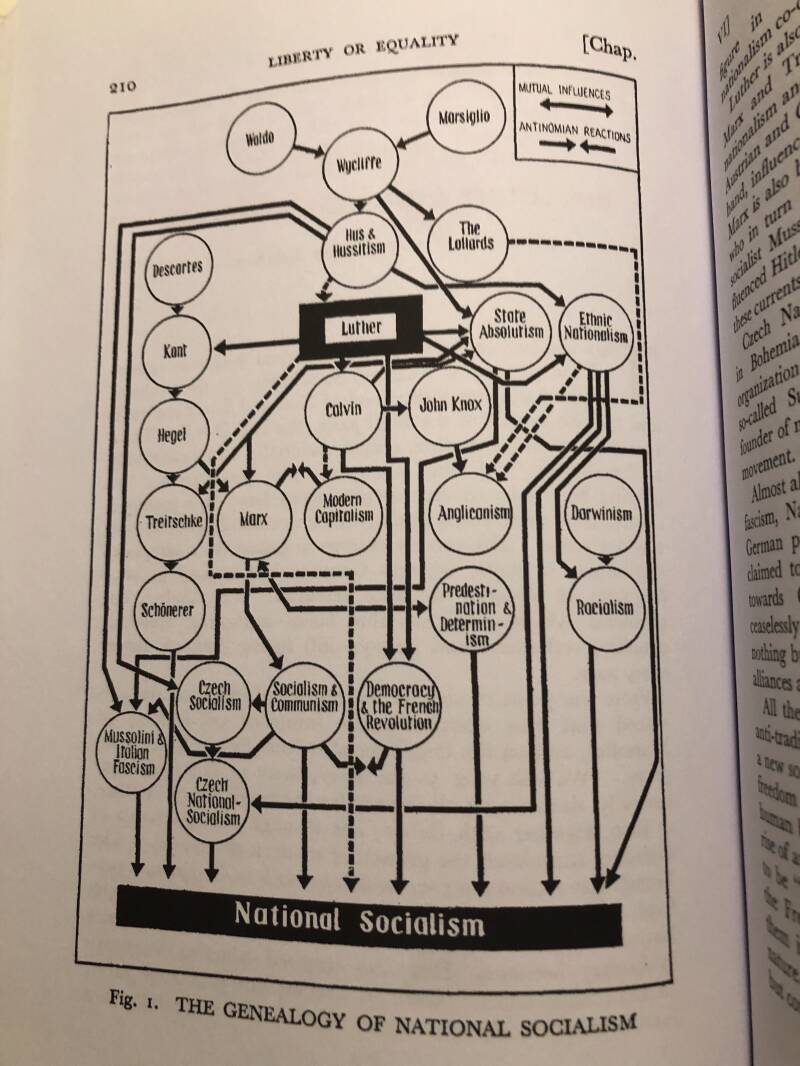
This chapter traces the roots of National Socialism (as a totalitarian movement) to Jonathan Hus, under the conviction that Hus influenced Luther and German nationalism, Luther in his turn influenced Mussolini and the Czech socialist party. Moreover, the French Revolution is said to have been influenced by Jansen and Calvin. It is said that ethnic nationalism and democracy worked together most closely. None of the ideologies in the picture claim to be liberal, all claim to be democratic, the author notes. He sees parallels between Luther's rejection of reason, a fundamental break with Catholic tradition, and the acceptance of 'irrational values' by the Nazis, a conflict between power and authority.
"In the concrete sense of the term, the notion of despotism and usurpation could hardly exist for Luther. Hence the gravity of the accusation of having laid the foundations for modern German tyranny." He is thus considered a source of illiberalism.
In opposition to the Nazis, it is said, are Prussian virtues, which are protestant, and on the other hand a 'reactionary' Catholic bulwark. These two formed major stumbling blocks for the Nazis.
- Chapter VII: The Rise of the National Socialist Party; the genesis of a totalitarian movement (part II)
The reader is once more reminded of the distinction between the democratic and liberal principle, and that continental European democracy tends to dispose liberalism more easily than Anglo-Saxon democracy. Parliament is described as not being a liberal/libertarian institution in nature, and all modern totalitarian movements are democratic, with the French Revolution as their prime mover. Regarding Hus "It is less well-known that, in spite of his Czech nationality, Hus strongly inspired German nationalists as a protagonist of ethnic 'folkdom' and as a hero of 'anti-Romanism'." (page 249). Attention is also given to Miroslav Tyrs/Thiersch in particular, citing phrases like "Personality is nothing - totality is all".
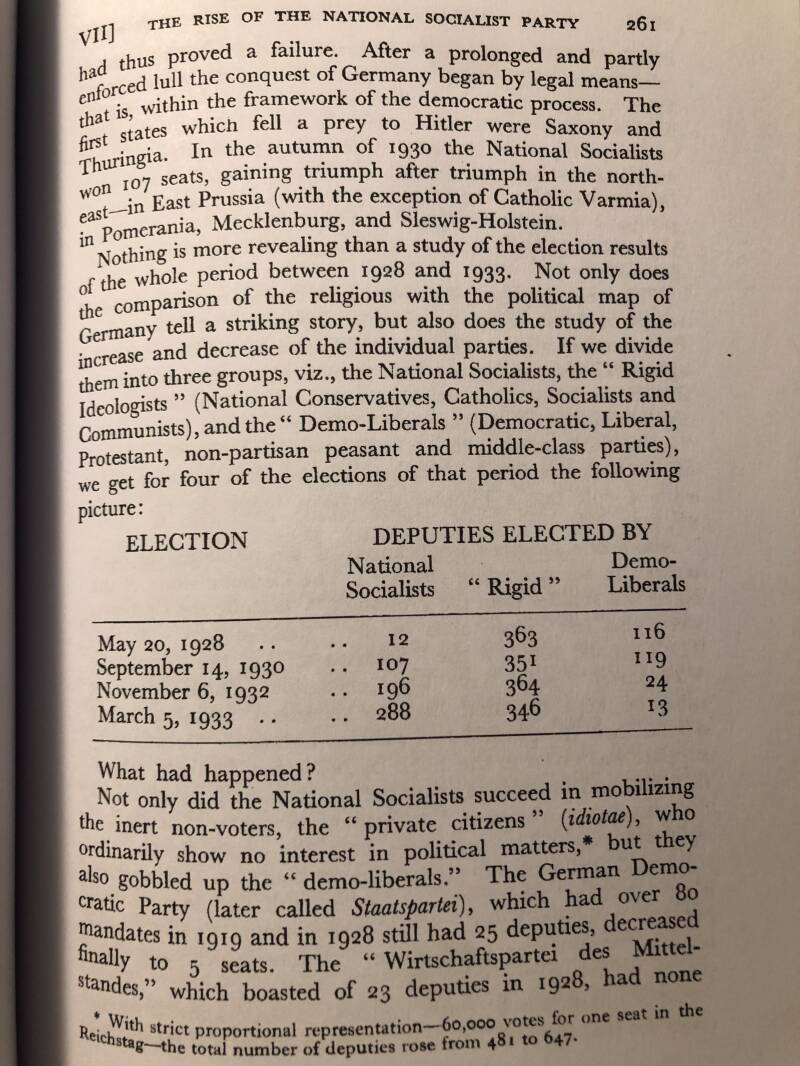
Regarding Hitler, who styled himself as a true democrat who was about to ennoble the German worker and the rise of National Socialism, the table on page 261 clearly shows how votes increased almost exponentially by usurping a large share of the 'Demo-liberals', see on the left. The "Rigid" category largely remains constant. Finally, there was a close symbiosis between German National socialism and Czech socialism.
- Chapter VIII: Postscript
The last chapter is devoted to the question of what the proposed system would be if liberalism is to be preserved, and given the criticism on democracy. A government from above, minimalist in size and of high quality is the main suggestion, based on the principle of federation, as a Royal Free State. (Extrapolated towards today, the EU may draw on this idea for a liberal constitutional order, though not a Royal one per se, but respectful of constitutional monarchies and internationalism.) As the author notes, "( The individual person, the very last unit, is fundamentally always "self-governing". Democracy becomes a rational proposition if the danger of mass anonymity and irresponsibility can be avoided, and if the otherwise so dangerous gap between the issues under judgement and the general level of knowledge is practically absent."
With this phrase we end the summary, and it highlights perfectly why individuals who defend the Rule of Law and report breaches must be protected and celebrated as a hallmark of liberalism and individual freedom.
Application to Calibrated Capitalism
Since our mission statement has been given, our interest is not in supporting a preference of monarchy over democracy, which we do not have. Our goal is to apply the critiques and other observations of this book to strengthen liberalism instead, the liberal economic and liberal democratic framework. An important lesson from the cited collectivist examples is that problems related to capital, international power and elites are best solved through a via negativa approach regarding illiberalism, i.e remodel what is not liberal, but leave the liberalism itself intact, instead of ideological weaponisation and mob rule.
Portland Declaration
For those who are interested, Kuehnelt-Leddihn wrote the Portland Declaration in 1981. We see some resemblance to the Basic Rights in the German Basic Law, yet we also think several elements in the declaration are based on falsehood, especially title 6 and 7 regarding Right as fundamentally Right and Left as wrong. Other aspects, such as the notion on the uniqueness of each individual and the principle of Subsidiarity are important in both the Basic Law and EU Law. We regard his scepsis on democracy as evident from the summary as exaggerated and counter-productive, as it contains a strong assumption that democracy will fail, with little room for different interpretation. This should in fact be an argument to strengthen militant democracy. Yet the distinction between liberal and illiberal remains very relevant. The authors perceived benefits of Monarchy have largely to do with mean-independence, i.e decision-making based on objective rather than subjective criteria. This is a relevant criterion in any type of liberal State/liberal organisation (but not in those organisations where 'vulgar' commerce/politics is an end in itself, for example in black markets or in totalitarian dictatorships).
Since the author is vehemently opposed to the French Revolution (he lived in a different era), this would suggest he in many ways is opposed to the whole distinction in Left versus Right, which is a bit self-contradictory. The division did not really exist in a political sense before the French Revolution, rather what was successful in a liberal/ objective sense was right and what was not was wrong. One could argue that historically, individuals and organisations that succeeded had a better grasp of objectivity than the rest. One reason the French Revolution succeeded may well have been that previously successful elites succumbed to their own decadence.
So we stick with the distinction between liberal and illiberal and do not take his division into Left and Right for granted. The religious influence may in fact involve an illiberal bias against modernity and separation of Church and State that is counterproductive. Attempts to remove such separation may in fact turn back the clock and constitute a form of State Capture.
We think the Portland declaration is interesting for comparison with German Basic Law, and should there ever be, it might provide input for a European Constitution. (Recall that the draft of 2003 has been rejected by referendum in 2005).
Below is a summary of the Portland Declaration. Note: We did not write the summary, mind the quotation marks.
"The Portland Declaration: A Summary
In the Free World II a beleaguered fortress, it has become imperative to formulate a vision based on a coherent outlook which can be shared by most of us. These, then, are the main points of such a creed in a short version:
1. Our immensely complex universe can only be the result of either mere chance or a conscious design. We believe that it has an Originator as well as a Designer– God.
2. Only to man can this world be meaningful in every respect: spiritually, morally, aesthetically, economically.
3. Only man is a transcendent creature. He realizes that, if there is a personal God, everything is possible, if there is no God, everything is permissible.
4. Every man or woman is truly a person and unique. No two persons are identical or equal, least of all in the eyes of God.
5. With the beasts we share a craving for sameness, but the delight in the variations of creation distinguishes man from beast as much as religion and reason do.
6. Sameness and with it the dislike of otherness is the hallmark of leftism: it is an evil totalitarian instinct which fashioned the French, Russian and German revolutions with their gaols, guillotines, gallows, gas chambers and Gulags.
7. In all languages, whether dead or modern, “Left” stands for negative, “Right” for positive principles.
8. Men and women are equally important, but their innate characteristics favor (and sometimes rationally preclude) certain occupations and vocations.
9. The family is the living cell of every society. (Man is the creature who knows his grandfather.) It is based on sex, eros. friendship, affection and charity, friendship being the most important factor because loyalty pertains to it rather than to sexuality or Eros.
10. A healthy society is not a monolith, but consists of various well correlated lasers and groups with different qualities and functions. However, neither society nor state should be permitted to become absolutes.
11. The state is the result of man’s frailty and incompleteness, Its legitimacy rests not only on authority but, due to Man’s fallen nature, also on exterior power. Authority rests on love, or respect, or rational insight, it is an interior force.
12. The state has an “annexationist” character tending toward centralization and the development of a Provider State. We must uphold the principle of subsidiarity. Action should always be taken by the smallest possible unit. starting with the person.
13. What we now have is maximal government of the lowest quality; what we need is minimal government of the highest order.
14. There is no escape from “technocracy.” Reason, knowledge and experience must reenter government at the expense of popularity and passions. Parliaments should faithfully mirror public opinion and might have purely legislative powers, but they must not become policy-forming bodies. Government should rest on first-rate expertise and respect for personal freedom.
15. Freedom is inseparable from personal property, socialism produces only equality in poverty.
16. The family can delegate its educational tasks to other bodies. Nobody should be taxed for educational facilities not used by them. It is, however, in the interest of the community that real talent (and diligence) should be fostered.
17. The identification of state and religion is pagan. Their separation, however, should not preclude cooperation because they have common interests and overlapping fields of action.
18. Ethnicity, race and citizenship are separate concepts, the first being cultural, the second biological, the third legal. They should not be confused. Legal discriminations or automatic preferences on account of ethnicity or race in the public-sector are plainly immoral.
19. Only a person with convictions has a genuine possibility to be tolerant. He who accepts no absolute values but clings to polite doubt cannot be tolerant but merely indifferent. He is morally defenseless in the face of evil.
20. Tradition, i.e., loyalty toward inherited convictions and institutions, which includes discarding obsolete or false ones, has a positive value.
21. The good man is a patriot and not a “nationalist,” he delights in the human varieties within his country.
22. Foreign relations require an enormous amount of knowledge and experience. They are intrinsically connected with our survival. International institutions can be of great value, but the United Nations in their present form and in the present state of our globe has often produced more harm than good.
23. Professional armies are, for various reasons, preferable to armies based on conscription, but if the latter system is adopted by certain world powers, others might have to follow suit — at least temporarily.
24. Legal positivism has no moral moorings. Justice is not equality but is based on Ulpian’s “to everyone his due.”
25. Man has rights as well as duties and these must be distinguished from acts of charity which might become moral, but not legal obligations.
26. Freedom is not an end in itself but a condition to live and to act in. “As much freedom as possible, as much coercion as necessary.” The common good marks the limits of freedom."
Add comment
Comments