
Attention: This article is a long-read of about 5,500 words and contains in-depth analysis of the Efficient Market Hypothesis and historical interpretations; State Aid and Monte Dei Paschi's accounting; aspects of the Egrant inquiry and the trial of Mr. Yorgen Fenech, Parex bail-out and suspicious transactions involving former Pilatus Bank. Several account numbers from Pilatus bank caught our attention, which can be found on page 949 of the Egrant inquiry.
"Money is the barometer of a society's virtue." This is part of a phrase coined by Ayn Rand, founder of a philosophy called Objectivism. A clearer defence of functioning pricing mechanisms is hard to find. Whoever has read Atlas Shrugged has encountered it (page 413). What does it mean, and how accurate is it as a general statement, and in application to the EU?
As discussed in an earlier article, perfect ergodicity is when (economic) theory can be applied to practice till infinity without causing a problem/blockage along the way. If this is so, theory adds up with practice. In an economic sense, that means the theoretical, monetary values assigned to productive activity are consistent with their worth in a real sense, i.e the notional value of the economy is consistent with its real value. How do we measure both?
Notional value is assigned through money. This article argues that the accuracy of money as a barometer of real value depends on three things: i) shared understanding of value and productive activity through objective criteria/law ii) ability to channel money to productive activity ie. economic virtue effectively iii) ability to counter rent-seeking /black markets i.e economic vice in practice, and other market irregularities.
The following assumption underpins the article: inability to measure economic virtue (false negative) or to detect economic vice in black markets (false positive) contribute to moral hazard and tail-risk. The space in that domain is considered illiberal and from there (negative) black swans can arise.
i) on shared understanding of value through law
Law has been around for several thousands of years, making good conduct possible on paper and in practice. Early documentations of law start with the code of Hammurabi, as scholars such as Taleb have noted (see Antifragile, 2012). There are several sources of law, which include: Greek and Roman law, religious law, natural and secular law. Natural law is sometimes described as eternal law, a topic covered by scholars such as Hans Hermann Hoppe (see from Aristocracy to Monarchy to Democracy, 2014), marking definitions of good versus bad regardless of time and spatial context. Religious law often approximates this, albeit through different sources and practices in regions, which occasionally have conflicting directions, such as orthodox Islam in the Middle-East versus several forms of Christianity in Western-Europe.
Secular law has been around for less time, and its introduction can be traced back to the Enlightenment and the French Revolution, as evident from literature by thinkers such as John Stuart Mill, Adam Smith, David Hume and Friedrich von Hayek. Whereas the Enlightenment aimed at introducing science and empiricism as opposed to religious dogma in a liberal sense, the French Revolution went a step further by attaching scientific methods discovered to political practice and ushering in democracy. This conclusion can be drawn from several books, such as 'Considerations on France' by Joseph de Maistre (1796), 'Reflections on the Revolution in France' by Edmund Burke (1790) and 'Napoleon and the Art of Leadership: How a Flawed Genius Changed the History of Europe and the World' by William N. Nester (2021).
Whereas the first can be said to deliver input for secular law, the second one took it to the political stage and put an end to the religious law as a framework for the whole of society. Both have been characterised by major achievement, yet the first has been scrutinised for failure to account for limits to rationality and the second one for risks of excessive state-planning and rationalism/scientism (see for example Hayek's writings on liberalism and the concept of Rechtsstaat in the Constitution of Liberty). The French Revolution also paved the way for a division into left versus right in political/economic sense. We think this is somewhat outdated and instead focus on liberalism versus illiberalism.
When people produce, it is not automatically given that they take all these laws into account all of the time. Yet, law is reflected in their behaviour as individuals, producers and consumers. In this article we briefly explore the concept of Efficient Market Hypothesis and deviations from it, by identifying two categories of caveats.
ii) Ability to channel money to productive activity
The ability to channel money to productive activity is closely linked with the efficient market hypothesis. Optimal capital allocation occurs to the extent that the efficient market hypothesis holds, or to the extent that deviations therein can be accounted for. This requires recognition of mismatches in the money supply, the existence of black markets and externalities.
A comprehensive paper on EMH by Eugene Fama and Paul Samuelson from 2019 can be found over here: https://doi.org/10.4000/oeconomia.5300
Efficient Market Hypothesis: Hot or Not?
Under efficient market hypothesis, money is channeled efficiently under the assumption that individuals act lawfully, are rational and know what is best for them, collectively leading to optimal outcome, measurable through currency. Under this regime, there are no market failures, wrong externalities or black markets. Deviations from an efficient market by definition cause a deadweight loss when plotted in a standard economic model.
Some scholars argue that the efficient market hypothesis is achieved by approximation. This is somewhat disputable, for several reasons based on our findings:
- The Global Financial Crisis of 2008 revealed massive shortcomings in the market for mortgages, the difficulty of understanding complex financial products by issuers, investors and consumers alike. Models that were used, such as Value at Risk and assessment methods internally used by banks for their risk management turned out to be inaccurate, having led to mispricings in CDO markets and accumulation of Non-performing exposures. (see for example this paper by the European Central Bank).
- The EU has a relatively short list for money-laundering countries, while simultaneously several high-profile cases of money laundering have unfolded.
See the document on the right (OJ L 254 20.9.2016, p. 1).
- The Quantitative Easing programmes adopted in the Eurozone have stretched the limits of the European Central Bank's mandate for providing price stability, which required complements to Article 123 of the TFEU with measures such as emergency liquidity assistance.
- There has been one regime in particular that attempted to implement radical free market policies without any distortions. This was in Chile under Pinochet after the coup of 11 September 1973. The toll on human rights has been significant, with around 3,000 deaths, thousands more detainees and cases of exile and democratic parliament out of use, meaning that democratic state was essentially replaced by a radical private property order for the time-being as an all-encompassing substitute. What the alternative would have been is difficult to establish.
The attempts at enforcing the most unrestrained market system variant since 1975 was essentially put to an end due to a severe financial recession in 1982 following years of steady growth, after a series of nationalisations and bail-outs, which essentially contradicts the idea of a completely free market. After that, Chile adopted a Social Market System similar to European economies yet with more radical market thinking entrenched in its 1980 constitution and rebounced into a democratic direction.
The difficulties in upholding the most radical free market model and its crash may have given explanatory power to difficulties faced by the US and other Western countries in the buildup towards the Global Financial Crisis of 2008 and model mismatches, in the US in particular.
Below we analyse two caveats to the Efficient Market Hypothesis with real-life examples.
First caveat: Money Laundering, suspicious transactions and outright corruption
The EU Anti-Money Laundering and Counter Terrorist Financing list takes into account recommendations by the Financial Action Task Force. The full list can be found on the right and incorporates the requirement of the 5th AML Directive.
One of the first notable features is that all countries included on the list are third-countries, i.e non-EU countries. An article by EU observer from 2022 noted how short the list is as a consequence, which indicates that the EU assumes risks to money-laundering to mainly come from outside of the EU.
The Regulations that require the assessment method, assume a level of harmony within the EU when it comes to anti-money laundering controls. How accurate is this current list and are there any important omissions? This will be discussed in Part iii under 'Caveat One'.
Secondly, the question of what constitutes illegal market activity matters and whether these definitions are accurate. Any undue influence in the legal decision making regarding AML and black markets again can have an adverse effect on the legitimate part of the economy. This could be the case when, for example, accounting modifications are applied that are mainly used to keep financial risks hidden that would otherwise be detected. Or there could be derogations in UBO registries that allow for restrictions on public registry for precisely those (shell) companies that carry a critical risk with them.
A second caveat: unusual market procedures
Unusual market procedures is not an official legal term. In this article, we count among those transactions that defy the ordinary rules of supply and demand in the market. State Aid transactions fall under this scope as the government intervenes to achieve a certain outcome in the market. Among the available tools are the usage of contingent liabilities, reversible transactions, bail in mechanisms and others. Unlike money-laundering, these are not a vice per se and can serve legitimate purposes.
These procedures often achieve an equilibrium or outcome that would not be achieved if completely left to market forces. Reasons for these deviations may be the preservation of stability, prevention of deteriorating investments or problems in liquidity provision as evident from EU law on State Aid, and adjustments made in for example ESA-95 accounting norms (see on the right).
A particularly relevant firm from the perspective of State Aid is Monte Dei Paschi di Siena. Several transactions and procedures in relation to his bank will be covered in Part iii under 'Caveat Two'.
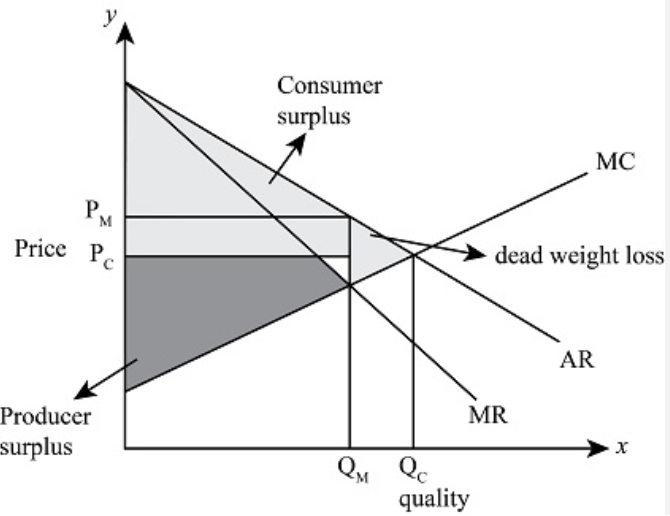
This snapshot represents a simple market-model with the inclusion of surplus specifications. The graph clearly shows that that raising prices to monopoly level instead of competitive level leads to a loss in efficiency, called dead weight loss. The value of the deadweight loss measures the degree to which the efficient market is distorted.
Above document shows the EU's list of high-risk jurisdictions regarding money laundering.
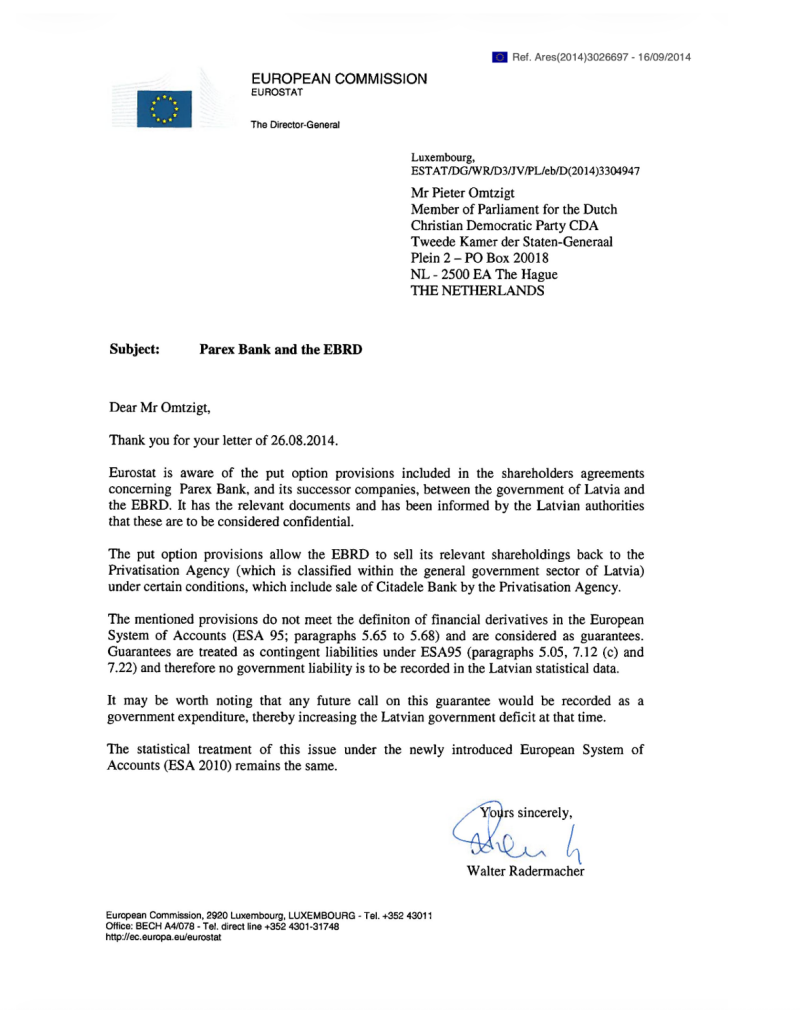
Above letter is a response from Eurostat concerning adjustments to ESA 95-norms. Since the time of writing, it has become legal to use certain categories of put-option agreements. It is available through several sources, though not on Eurostat itself
Above Council document represents the first EU AML Directive.
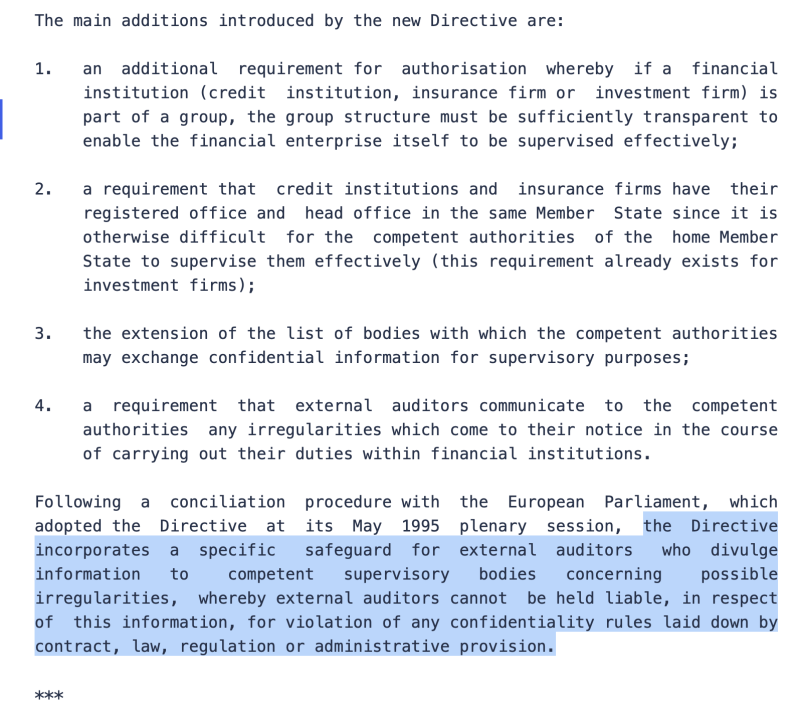
Excerpt of "post-BCCI" Directive of 1995. Source: https://ec.europa.eu/commission/presscorner/detail/en/ip_95_640
5th AML Directive

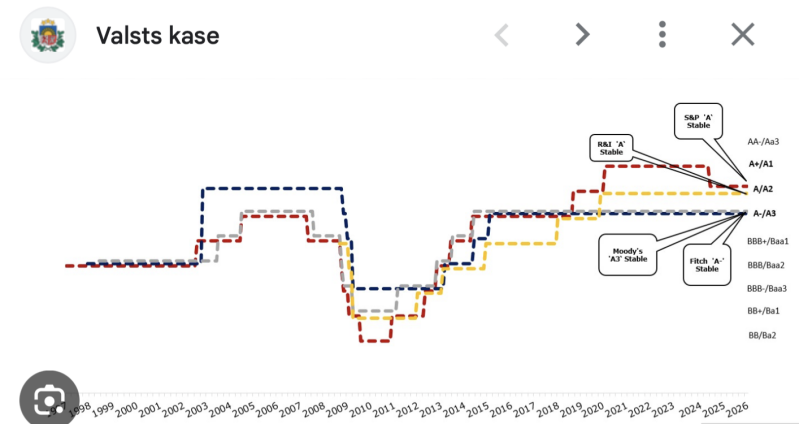
Excerpt from Bank of Latvia on Latvia's credit ratings from 1997 till 2026. Source: https://www.kase.gov.lv/en/investor-relations/credit-rating
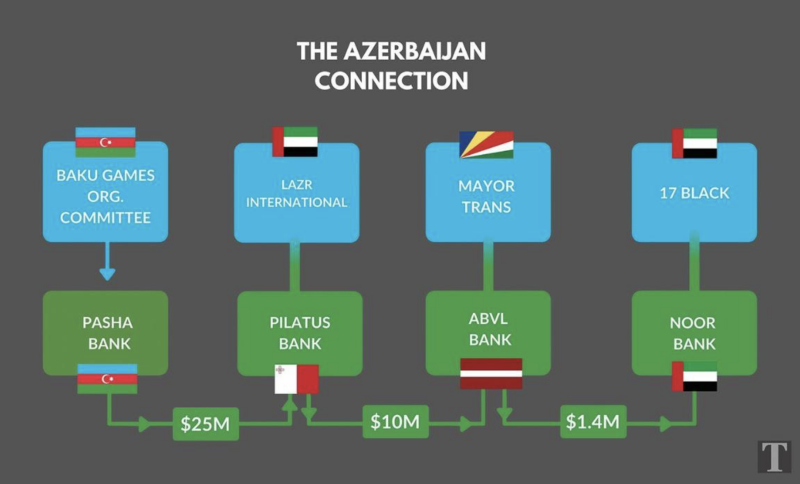
Excerpt from Times of Malta Displaying the Money Laundering Scheme with 17 Black as its final destination.


Above are several excerpts of the Egrant inquiry report, namely p. 949, 1250-1251, 1290-1292.
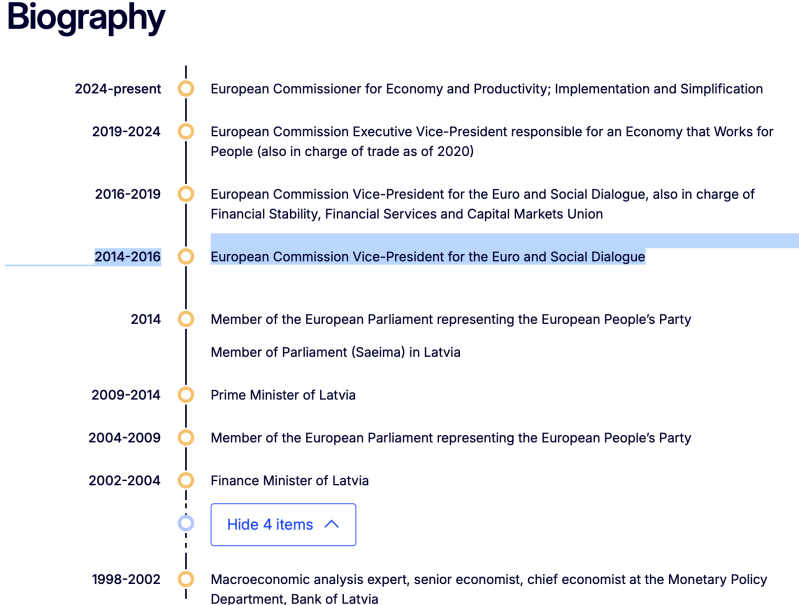
Video discusses Valdis Dombrosksis' stance on Latvian Credit ratings and Eurozone entry. https://www.youtube.com/watch?v=Si5duMdzBbU), and biography below.

iii) ability to counter rent-seeking / black markets (economic vice) and their side effects in practice, and other market irregularities
First Caveat: Regarding the EU's AML framework, Parex, Pilatus, ABLV, and the case of Yorgen Fenech & 17 Black
In part ii, several sources of rent-seeking and black markets have been identified. Particularly sensitive is the shadow-banking system, as are several entry points in politics. One observation is that usage of reversible transactions/contingent liabilities can burden governments with risks that are hard to oversee a priori. Likewise, from an investor's perspective, these can lead to seemingly attractive investments, of which the damage will be done later on.
An important justification for these agreements is to maintain stability in the short-to medium run, as it is not uncommon for these agreements to last several years. It also means that several parts of the market are largely exempted from scrutiny.
A core requirement to solve money laundering and black market problems then is to assume that absence of evidence is NOT evidence of absence, while making sure no accusations are made of problems unless there are reasonable grounds or tangible proof. Several examples show how EU institutions and agencies have responded to cases of (alleged) money laundering, starting from the beginning, when the EU introduced its first Anti-Money Laundering Directive in 1991 , shortly after adoption of the Maastricht Treaty and the collapse of the Soviet Union.
One of the first cases of international money laundering with an EU-dimension was the Bank of Credit and Commerce International in 1991. The bank was founded in 1972 by Agha Hassan Abedi in London, and located in Luxembourg in avoidance of banking nationalisation by Pakistani Authorities as can be seen in this 2005 article by the Guardian. Early signs of money laundering can be observed in 1988 and 1990. In 1991, the Bank of England ordered BCCI's auditor, Price Waterhouse Cooper to conduct an investigation.
During that investigation, it was found that BCCI systematically conducted transactions for which the purposes were either unclear or with the intention of obscuring the intended activity, with years of fraud. This led to the closure of BCCI in England, and a litigation case against the Bank of England by the liquidators of BCCI hase pended for more than a decade until it was finally dropped in November 2005. It was at the time concluded to be one of the biggest banking scandals in history, with an estimated value of around $9.5 billion according to a 2026 post by Veritas Europea.
In 1995, the EU responded with a so-called post-BCCI directive (Directive 95/26/EC), which strengthened the Supervisory Authorities powers to monitor financial institutions. A key requirement for credit and insurance institutions was that their registered office and head office are in the same Member State. Moreover, due to the requirement for external auditors to report irregularities, in doing so they could no longer be held liable for confidentiality breaches.
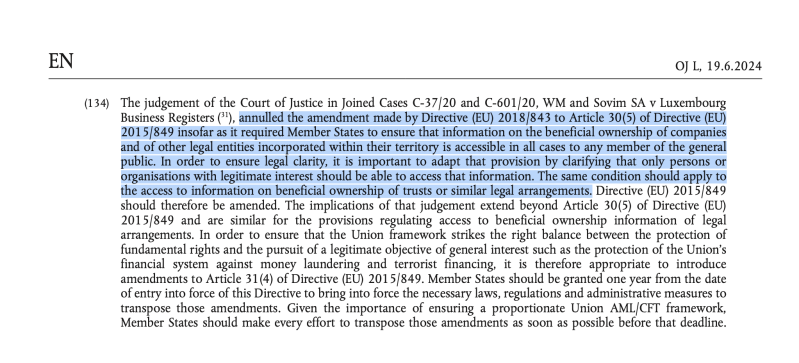
Subsequent changes have been made to this Anti-Money Laundering Directive, resulting in the 6th AML Directive, adopted in 2024. The document can be found on the left. Its legal content shows that the Directive takes case law into account for the amendment in 2018 of the previous directive , which dated back to 2015. The cases concerned are Joint Cases C-37/20 and C-601/20 (ECLI:EU:C:2022:912), WM and Sovim SA v Luxembourg Business Registers, and led to more lenient registry requirements, such that only persons or organisations with a legitimate interest can access information on beneficial ownership. This indicates a tradeoff between data transparency and privacy.
To solve this issue, the BORIS was introduced (Beneficial Ownership Registry (see EU legislative train on AMLD 6) which links together beneficial ownership registries across EU Member States borders to allow for more effective exchange of information. The problem with assessing its effectiveness is that this can only be proven on what is known already, whether or not it is the tip of an iceberg.
Three strikes and you're still in? Parex (spin-offs), Pilatus and ABLV versus the 5th AML Directive
Based on earlier research and other available data, we can identify several large-scale money-laundering cases involving the following banks that have jumped through the existing AML Directives' radar before the 6th AMLD was adopted.
- Parex Banka (Latvia, liquidated in 2009)
- Pilatus Bank (Malta, closed down in 2018)
- ABLV Banka (Latvia, liquidated in 2018)
A recurring theme with each of the three cases is the involvement of senior government and bank personnel, and the threat that investigators and independent auditors have faced, and difficulties in establishing the Ultimate Beneficial Owner in the case of shell companies involved in suspicious activity. The threshold for Ultimate Beneficiary Ownership varies per jurisdiction, yet "it is commonly agreed that an ultimate beneficial owner or UBO owns more than 25% of a company’s shares or controls more than 25% of the voting rights." according to credit rating agency Moody's.
Parex Banka: Former financial protegé for Kremlin and other post-Soviet elites
Parex Banka was incorporated in 1992 by Valērijs Kargins and Victor Krasovicis, and was Latvia's largest independent bank and its second-largest bank as such, with around $5.6 billion of assets, up to the Global Financial Crisis. As early as 2005, John Christmas, former director had warned authorities and auditors (including Ernst & Young) of systemic lending to related parties and fled his country after facing threats. Senior central bankers such as Ilmārs Rimšēvičs were informed too about the connections with Russian organised crime and oligarchy according to available sources. There is proof of this, for example Parex provided a uncollateralised loan of $111 million to Eduard Khudainatov, a straw owner of one of his yachts and former CEO of Rosneft, mentioned in a 2012 article by Pietiek . After the collapse due to money-laundering and asset theft, Mr. Rimšēvičs was a key figure in meeting Eurozone requirements such as respecting the threshold of public deficit of no more than 3% of GDP, being appointed by Valdis Dombrovskis. In order to comply, a secret put-option agreement was used which involved the European Bank for Reconstruction and Development as holder of a 25% plus one share equity-stake (technically being debt-holder). It was reversed later on and was basically a risk-free investment for the EBRD, with losses borne by the Latvian State. Following the restructuring, it automatically gave the EBRD a stake in Citadele A.S.
Mr. Rimšēvičs was arrested and brought to court Joint cases Case 202/18 and 232/18 (ECLI:EU:C:2019:139) after several years of service in the Latvian government and subsequently as a governor of the ECB. In 2023, a verdict resulted in a jail sentence of six years by the Riga District Court, after received bribes by Trasta Komercbanka in the amount of €250,000 were proven as noted by this article from Comsure Group. The reported reason for capping the bribe at €250,000 was due to Mr. Rimšēvičs inability to do as asked in full, in which counterfactual the amount would have been €500,000.
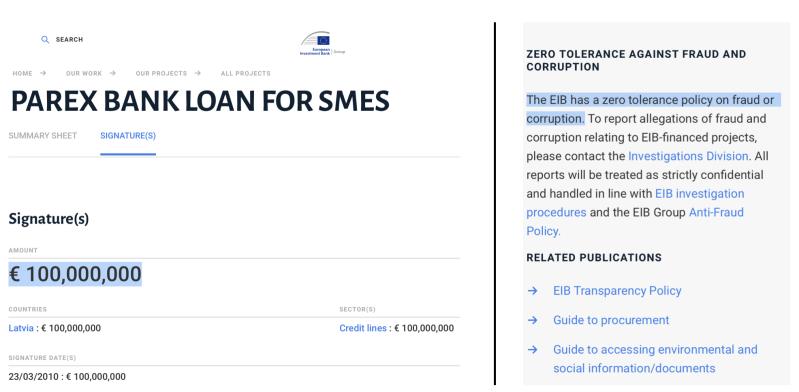
Parex was officially restructured into Citadele Banka on 30 June 2010, as well as Reverta as a 'bad bank'. The excerpt on the left on credit rating development shows a significant drop in credit outlook for the Latvian government by all four major ratings agencies following the Parex collapse in 2009, with ratings reaching subprime levels. At the time, the Latvian State incurred a loss of about €767.5 million (Decker, 2024. DOI: http://dx.doi.org/10.2139/ssrn.4779811), after having required an assistance package worth around €7.5 billion (Reuters, 2010) to prevent further deterioration, which included assistance by the IMF and European Commission. Moreover, in 2010 a €100 million credit line was approved by the European Investment Bank (roughly equal to the value of Mr. Khudainatov's uncollateralised loan). The first paragraph below that statement has been included, which indicates the EIB has zero tolerance on fraud and corruption. It is unclear whether that paragraph already existed at the date of the signature (2010) or if it was inserted later on. The losses of Parex have largely been incurred on Reverta's write-off.
A study on Subordinated Debt conducted by the European Parliament in 2018 includes a chapter on Bail-ins between 2013 and 2015, and concluded that Parex shares were left intact during the bail-in. This is somewhat misleading, based on information in above paragraphs, the table has been added next to the excerpt of Pietiek's article on Mr. Khudainatov's uncollateralised loan of $111 million as reported.
The Latgale Regional Court ordered Mr. Kargins and Mr. Krasovicis to pay €124.3 million in 2021. In 2022, only €540,000 has been recovered, 0.43% of the 2021 claim.
Pilatus Bank: alleged former host for Egrant and 17 Black's dirty money and some other peculiar things
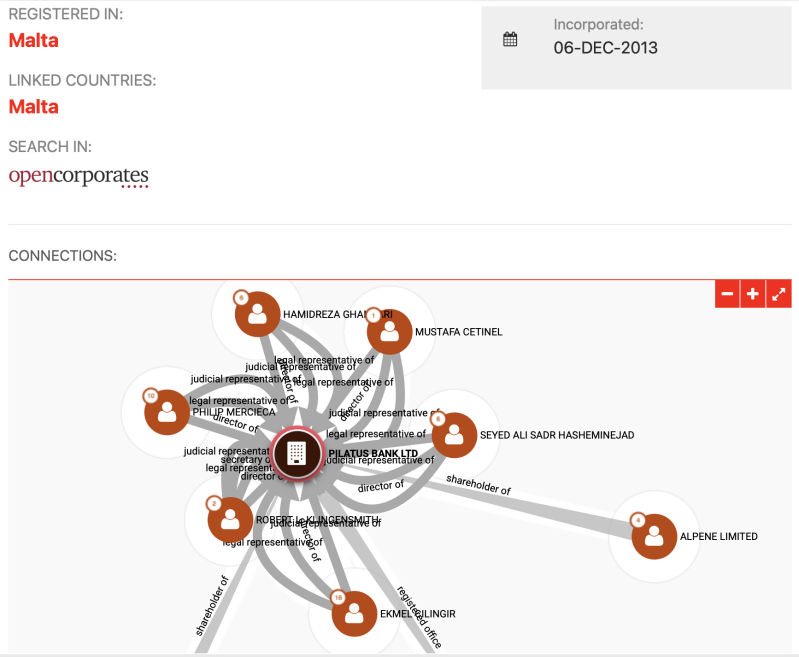
Pilatus Bank was incorporated on 6 December in 2013 in Malta, with Ali Sadr Hasjeminejad as its former Director. The bank was shut down in 2018 due to embezzlement, after its banking license was revoked by the European Central Bank. Loss due to corruption at and liquidation of Pilatus Bank -> death of brave investigative journalist Daphne Caruana, and the exile of whistleblower Maria Efimova, who claimed to have documents proving the Ultimate Beneficiary Owner of Egrant, a shell company established in Panama. This led to a weaponisation of the 'machinery' of Interpol, for the arrest warrant aimed at Maria was based on questionable foundations. As Greece refused to hand her over to Interpol and back to Malta (that was after the assassination of Daphne in 2017), Cypriotic authorities went after her husband as evident from this reporters united article.
Of particular importance is a shell company called 17 Black, registered in the United Arab Emirates, which received around $1.4 million worth suspicious transactions through Pilatus Bank as well as money from Baku Games Org. Committee, which connects with Efimova's allegations of funds that the shell company received from the Azeri Ruling family. Part of this scheme also flowed through Latvian bank ABLV, (ABVL is a typo) see chart on the left excerpted from Times of Malta.
This shell company was alleged to have served as a laundromat that connected Azerbaijan with Malta and other countries, and suspect in the assassination of Daphne Caruana is its owner, businessman Yorgen Fenech, who is currently facing trial (more on that later).
The full 1,500 page report on Egrant details the Egrant inquiry and has been conducted by judge Aaron Bugeja. In the report, here is no conclusive judgement regarding Egrant's UBO, yet the inquiry according to this article by Malta Today indicates there is no document indicating anyone else to be owner of Egrant than Brianna Tonna. According to this newsbook article, Mr. Bugeja himself has admitted that it was never a goal of the inquiry to find out who the UBO is. This raises some questions on the inquiry's neutrality.
The conclusion could be disputed to the extent that Mrs. Efimova can credibly signal to possess a document claiming other ownership of Egrant, which she says to have. She alleges Mrs. Muscat is the UBO and claims to be confident about the authenticity of the underlying document. Companies that received attention during the Egrant inquiry and before include Sahra FZCO and Shams al Sahra FZCO (see excerpt on the left), two companies close to each other, located in the United Arab Emirates. Sahra is claimed to be owned by Leyla Aliyeva, daughter of Ilham Aliyev and Shams al Sahra FZCO is reportedly owned by the Heydarov family. An excerpt from the Guardian says:
"An audit of a bank owned by Gilan declared that in 2013, the group was ultimately owned by two entities: Sahra FZCO, with 51%, and Shams Al Sahra FZCO, with 49%. The Heydarov brothers were named as joint owners of these Dubai-registered entities. The P.O Box numbers of the firms indicate close proximity to each other. However, two sources with knowledge of Pilatus transactions have now confirmed that the owners of Sahra FZCO were declared to Pilatus as Leyla and Arzu Aliyeva." This can be confirmed by reading the inquiry report on the excerpt of page 1292. Excerpts of page 949, 1251, 1290, 1291 and 1292 of the inquiry can be found on the left.
Payments towards a Dubai-based firm named Palma Management Consulting DMCC have been established , and according to Mrs. Efimova, Shams al Sahra had account number 101731 at Pilatus Bank (can also be confirmed, see excerpt of page 949 of inquiry report on the left), consistent with Daphe Caruana's allegations of money that was transferred from Mr. Aliyev to Mr. Muscat, as noted by the Artsakh news article. The payments in question could not be proven in the Egrant inquiry, yet it must be stressed that the observations were based largely on evidence provided from within Pilatus Bank, which was shut down for corruption after all.
Forensic analysis stressed that there is a possibility that a third company has been used to transfer funds from Palma Management Consulting to Egrant, see the excerpts including page 1291. A question that remains is whether or not 17 Black and Egrant are related to each other or not given that the first was specified as ultimate destination for payments from Tillgate and Heamville when consideration was made to open bank accounts at Pilatus for both (see excerpt of page 1251). Why has 17 Black never been mentioned again in communication with Pilatus? Would it be useful e.g to conceal a link with Egrant so that it appears at the back-end of payments flowing out of 17 Black from Dubai that have first been received by either of the other two companies? There is no conclusion on this, certainly no legally binding one, any suggestion on this matter remains speculative.
Pilatus Bank was ultimately shut down in November 2018 following the arrest of Ali Sadr Hasjeminejad in the United States due to alleged Money Laundering, as reported by OCCRP.
ABLV Banka: a former Center of Gravity for dark money in the EU
ABLV Banka was incorporated on 17 September 1993 in the city of Aizkraukle. The bank was liquidated in 2018 after having been identified as a financial slush fund for transactions facilitating the North-Korean nuclear arms programme and Central-Asian laundromats, among others. The total sum of money laundered through this bank is estimated at €2.1 billion by OCCRP, though the number could be higher based on estimates by US FinCen, having triggered Article 311 of the Patriot Act in 2018. Somewhat ironically, in the 2024 statement FinCen mentioned that ABLV was no longer a primary money-laundering concern after reforms taken by Latvian authorities, not mentioning the bank had been liquidated already. In an attempt to conduct independent assessment of the bank's value based on its financial statements, independent Auditor Martins Bunkus was fatally shot in front of his office in 2018, resulting in a sentence for Mihails Ulmans of 15 years.
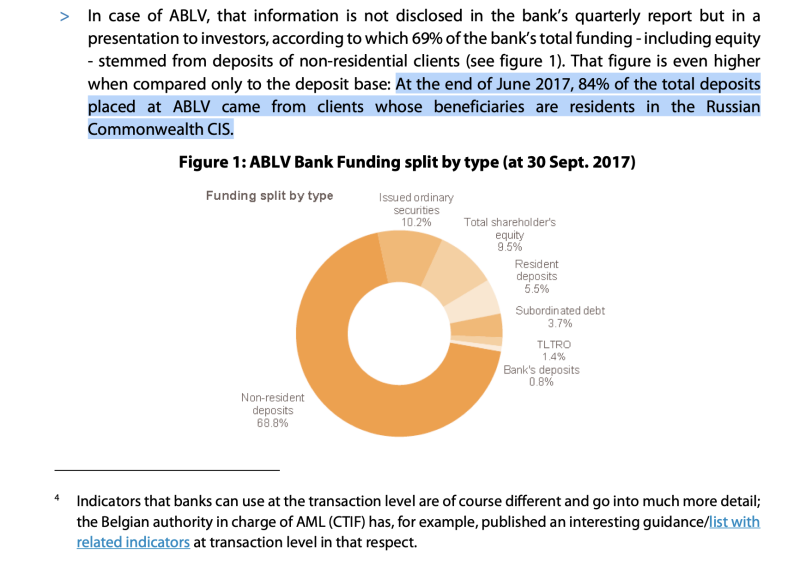
The main trigger for EU to close down ABLV was not so much money laundering. Instead, the ECB determined that the bank was 'Failing or Likely to Fail' under Article 18 of the Single Resolution Mechanism Regulation. The Resolution Board concluded it was not in the public interest to save the bank, resulting in liquidation in 2018. A recurring theme in all three cases, not least ABLV, is the presence of webs of shell companies, whose Ultimate Beneficiary Owners are often difficult to track and connects these banks to each other. The chart on the left shows that in 2017, 69% of the banks funding came non-residential depositors (Report by the European Parliament). This number was given in an investors meeting instead of its quarterly report.
EU Commissioner Valdis Dombrovskis as the EU AML executive, coincidence?
The latest package regarding Anti-Money Laundering, AMLD 6 was introduced by EU Commissioner Valdis Dombrovskis to improve the existing AMLD and close potential loopholes. He was Prime Minister of Latvia at the time of the Parex bail-out, a hub for money laundering as discussed. It was under his rule that documentation regarding the put-option agreement was kept secret, so that deficit criteria could be met. Not doing so would likely have affected the credit rating of Latvia negatively at a time of severe crisis.
After having met the criteria for Eurozone entry, Mr. Dombrovskis became a key architect of Eurozone financial policies and grand schemes such as the European Banking Union, Capital Markets Union and the EU's Anti-Money Laundering defences, having made personal contributions to the 5th AML Directive already. In 2014 he became EU Commissioner and has remained active as such.
Given that aspects of the Parex bail-out and its aftermath were illegal under existing laws at the time (hence the cover-up of this put-option agreement under State secrecy law), it would be up to the European Commission to investigate whether or not unlawful State Aid has been provided, for which there could have been grounds as early as 2014 following discovery of the hitherto secret transaction. However, when one of the EU Commissioners has been responsible for handling the case/situation that could be subject to inquiry, question is if such an investigation will take place, and if it is based on objective triggers in law. This does not delegitimise his position as such, since emergency measures at home can sometimes overrule conventional policies, but it raises questions on whether Anti-Money Laundering and State Aid defences can be compromised due to internal conflicts of interest and previous cases of known fraud.
The case of Yorgen Fenech: symptoms of an anti-social market system?
Currently, a court case is pending against Maltese Businessman Yorgen Fenech, presided over by Madam Justice Edwina Grima, the trial having reached its 33rd day.
Mr. Fenech He was the owner of the Tumas Group until his arrest, which includes of the largest Maltese utility companies named Electrogas. It is alleged that he ordered the assassination of investigative journalist Daphne Caruana Galizia for €150,000 and spent €400,000 on subsequent legal fees to cover up the process, according to the Guardian.
Maltese Intelligence investigations from 2018 hinted at links between Fenech and the secretive entity 17 Black, so he was reported to be owner of 17 Black.
The allegation of having ordered the assassination are backed up with arguments based on emerging facts, with Mr. Melvin Theuma having confessed himself as the middleman for the assassination. Daphne Caruana was deeply involved in research into the dealings of Electrogas and 17 Black. A 2020 article shows that the Dubai-based entity made a €4.6 million Euro profit out of the sale of a windfarm in Montenegro towards Enemalta, Malta's State energy company. The total sale was worth €10.3 million according to suppressed audits, implying >40% of the proceeds went somewhere else.
17 Black no longer exists as an entity. In 2018, the firm was renamed into Wings Developments Ltd. In 2025, there has already been a court case, in which freezing orders of up to €18 million were imposed on Wings Development and related entities
Another article (by Lovin' Malta) mentions that Mr. Fenech sought to transfer up to €10 billion through foreign banks accounts on behalf of a Saudi contact, weeks before his arrest . He was arrested on 20 November 2019 and released on bail on 24 January 2025. Following a verdict on the 'Maksar Gang' for carrying out the murder of Daphne, Mr. Fenech has been put on trial again on 1 July 2026 for being the alleged mastermind.
No verdict has been reached on Mr. Fenech yet, and it is not in our scope to reach one. Mr Fenech himself has pleaded not guilty. But there also facts and allegations brought forward providing grounds to believe that justice may potentially not rule in his favour. Of specific interest is an E-mail to keep 'Special K' on the side of Mr. Fenech, as reported by The Shift this month.
Second Caveat: Regarding unusual market procedures in the case of Monte Dei Paschi
From the perspective of the second caveat, arising out of State Aid and unusual market procedure, Monte dei Paschi remains an interesting phenomenon. Banca Monte Dei Paschi di Siena is the oldest bank in the world, incorporated in 1472. The banks was originally a pawn agency for the Magistracies of the Republic of Siena, having been instructed to provide mainly banking activities to underprivileged classes. Following reforms through a Charter of 1624, it became a mainstream bank and depositors were given state guarantees by the Medici Grand Duke. Hence, a close link between the bank and the State was established. The firm has ISIN code IT0005508921. Its price can be tracked on e.g Euronext, which we have done too.
Monte Dei Paschi, accounting procedures, and involvement of the Italian State: Approved State Aid, sale of a 15% stake by the State through Accelerated Book-Building, and claims of alleged mispricing
State Aid has been defined under Article 107 and 108 of the Treaty on the Functioning of the European Union and is in general prohibited with specified exceptions. Monte Dei Paschi has received State Aid multiple times, with the first case of State Aid provided in 2009 and then again in 2012 and executed in early 2013. It was done in the form of precautionary recapitalisation in the form of hybrid capital instruments of €3.1 billion to comply with recommendations of the European Banking Authority after the bank suffered a loss of €4.69 billion in 2011. The specification can be found in European Commission Document C(2012) 9660 as it qualifies as State Aid under Article 107(1) and was temporarily compatible with Article 107(3) according to the European Commission. The full document as well as the extract can be found on the right (number SA35137). According to page 95 of the 2011 Annual Report, MPS has a balance sheet total of €240.7 billion for 2011 (see page 95 and page 248 in the right column somewhat below).
State Aid was once more provided in 2017 through precautionary recapitalisation worth €5.4 billion. The European Commission has cited that the Italian bank "had to implement specific measures to restore its long-term viability, minimise distortions of competition and ensure an adequate own contribution to cover losses and restructuring costs". Following an amendment in 2019, the Italian State was obliged to sell its stake by a certain deadline. Currently, no hard deadline is given, yet the Italian Treasury has signalled signalled plans to sell the remaining stake by the end of September this year (according to Bloomberg).
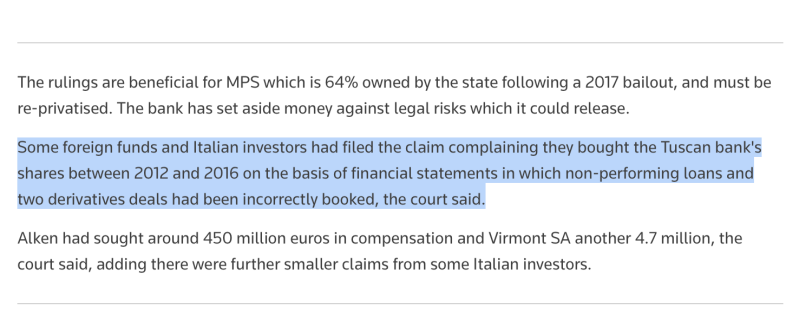
In 2023, MPS incurred €1.15 billion costs due to extrajudicial litigation claims. The reason for this was the complaint filed by several foreign funds and investors that they had overpaid for the purchase of shares of the bank between 2012 and 2016 (see excerpt on the right), according to Reuters. Grounds for these claims were incorrect statements on two derivatives deals and Non-Performing Exposures. If any misstatements on these have an effect on the balance sheet and earnings of MPS, this could have implications for the validity of State Aid granted thus far.
Following the decision of 9 November 2023 of Milan's civil appeals court (see Reuters) to dismiss $481 million (mind USDs, not Euros) in claims, a sudden increase in share price is visible, jumping from €2.70 to about €3.12 in the course of a week (this implies at least correlation and the perception of causality is not unfounded).
Several balance sheet items have caught our attention. In the column on the right, our excerpts show a recalculation of the following balance sheet items on page 95 of the 2011 Annual Report:
- Item no. "20 - Financial assets held for trading" was reduced to €3,308.8 million
- Item no. "60 - Loans to banks" was reduced by €900.1 million
- Item no. "70 - Loans to customers" was reduced by €908.3 million
Likewise, page 248 of the 2011 report mentions the inclusion of the following in the categories 'Deposits from banks' and 'Deposits from customers':
- interest on payables under repurchase agreements on: treasury securities; securities obtained through reverse repo transaction or securities lending: and securities from self-securitisations not recognised in the balance sheet.
In the 2011 report, there is no explicit reference to Alexandria, Santorini or Nota Italia, since this was before the leak of a 'mandate agreement' (more on that below). It is claimed that the shares had been mispriced due to incorrect specification of non-performing loans and two derivative deals in the financial statements. The article does not specify which derivative deals are involved, yet it is not unlikely to refer to Alexandria-Santorini. If that is the case, these derivative deals have a direct link to State Aid. A 2013 press release by Monte Dei Paschi (see on the right) mentioned that the group had processed the losses of Alexandria in 2012, and issued additional 'Monti Bonds' worth €500 million, confident that this would be sufficient to absorb the financial impact of meeting prudential requirements.
Monti Bonds were bonds subscribed by the Italian Treasury with private banks, to strengthen their capital base. The instrument type was signed into law by former Prime Minister Monti in 2012 through law 135/12 and 228/12 upon specific request by MPS, though it cannot be said they were only designed for MPS, since 70 other banks were included in the ECBs recommendation as reported by the Bocconi Students Investment Club. That page also offers a concise scheme with the specifics of Alexandria and Santorini derivatives.
The total value of Monti Bonds issued by MPS totalled €3.9 billion, for absorbing previous losses and to satisfy additional prudential requirements (ibid).
Alexandria-Santorini: More than holiday destinations
In the early 2000s, MPS engaged in several transactions used to keep certain exposures off balance sheet for the time being. Page 104-108 of the 2012 Annual Report discuss these exposures and three instruments used to hide them for several years until discovery of a 'Mandate Agreement' on 10 October 2012: these are respectively named Alexandria, Santorini and Nota Italia. We have included page 104 and a bit of 105 on the right. The agreement was leaked circa at the beginning of 2013. The claim results from the fact that two derivatives, Alexandria-Santorini were used by Monte Dei Paschi to hide approximately 2 billion Euro losses before the State Aid was approved, which could have been illegal under a counterfactual scenario had non-performing exposure not been hidden by the three mentioned financing constructions.
The Alexandria-Santorini deals are hence controversial, and 13 bankers were sentenced following a verdict in November 2019. Among those sentenced were bankers from Monte Dei Paschi, Nomura and Deutsche Bank, with the heaviest sentence of seven-and-a-half years handed to a MPS banker. Yet the verdict was subjected to judicial review and overturned after complaints by all three banks (in fact, the Reuters article discussing the sentence warns that first hand-outs in Italy are easy to overturn).
As of H1 2025, Monte Dei Paschi had seen an improvement in its credit rating towards BBB by Morningstar, which cited reduction in MPS' Non-Performing Exposures and reduction in litigation risks, according to this Morningstar update of 02 October 2025, citing favourable court rulings. Which court rulings it concerns has not been mentioned, it is not unlikely that a ruling of 11 December 2023 played a role, in which three former top executives were acquitted and an earlier conviction was overturned, reported by Reuters. Shortly before that ruling, the Italian Ministry of Finance sold a 25% stake in MPS for approximately €920 million on 20 November 2023, reducing its share capital in the bank from 64.23% to 39.23%. Following the sale, the share price increased and peaked at about €3.40, and dropped to about €3,00 afterwards. Whether it was a consequence of the sale and court ruling, or the result of a general year-end rally on the stock market requires more economic theory to draw conclusions on.
Another sale by the Italian State: a 15% stake valued at €1.15 billion
The bank has recently received attention for the Italian government has sold a 15% stake in Monte dei Paschi towards a small group of investors in November 2024, according to an article by Reuters of 13 June 2025. The sale is covered in another article too (https://www.reuters.com/business/finance/italys-stake-sale-monte-dei-paschi-under-eu-scrutiny-ft-reports-2025-06-24/). It was approved by law and the indicated purpose is the establishment of a larger consolidated banking group with Mediobanca. Yet it does defy ordinary market procedure.
The method used was a so-called accelerated book-building process (ABB). This procedure is used to sell investments overnight so as to minimise any market distortions. Such a process can be as short as a few hours. In the case of the Italian Ministry of Finance, it allowed the sale of the 15% stake for €1.15 billion. Question in that context is how accurate the price is.
The official document of the Italian Ministry of Finance notes that the "Requests were over twice the initial offer" , which makes sense given the increase of the sold share capital from 7% to 15%. Banco BPM acted as both Global Coordinator and book runner, and Clifford Chance acted as legal advisor. The stake of the ministry in the bank has been reduced from 26.7 to around 11.7 percent. (Source: https://www.mef.gov.it/en/ufficio-stampa/comunicati/2024/MEF-placed-15-of-the-share-capital-of-MPS-for-approximately-EUR-1.1-billion-00001/)
If any problems related to non-performing exposures and past losses have impact on the value of the 15% stake sold to new investors, the Italian State could have an active interest in witholding information that could influence the share price negatively, and an incentive to determine a price that favours Monte Dei Paschi. Without tangible proof, this remains only speculative but not completely unfounded.
The shares were sold at €5.792 each, as evident from the letter, which was 5% above the closing price of 13 November 2024. From 15 November 2024 onwards, there was a 90 day ban on reselling the shares on the market by the Global Coordinator and bookrunner, Gruppo Banco BPM that is. The price graph on the right is an excerpt from Euronext and shows the development of share price since that date up to March 2025. It can be seen on the chart that immediately after the closure of the price, the shares jumped to over 6 Euros each, after which it rose to about 7 Euros, following a drop again at around the time that the resale ban expired.
From the above, it cannot be concluded with certainty that the ABB affected the share price, yet correlation is visible. Given the extrajudicial litigation for alleged mispricing, two things would be relevant: i) Would information from these litigations and their outcome affect the value of the 15% stake? ii) If so, how would it affect the market price of Monte Dei Paschi's shares and does it lead to a less than optimal outcome in terms of efficiency?
Proposed Merger with Intesa and BPM and further reduction of State involvement as shareholder
There have been two important proposed deals regarding MPS, which have started in 2025 and for which negotiations continued in 2026.
i) MPS has proposed an M&A deal with Intesa Sanpaolo and Banco BPM in 2025 to form a larger consolidated banking group. The terms of the offer can be found over here with regard to Banco BPM.
This deal was ultimately rejected by Banco BPM in August 2026, as BPM has announced that it abandons the proposed Merger, due to objections by its main shareholder, Crédit Agricole .
ii) Intesa Sanpaolo has proposed to take over MPS. The terms of the offer can be found over here.
After rejection of the deal with Banco BPM, Monte Dei Paschi has considered to proceed with Mediobanca. Mediobanca publicly released its approved plan to be incorporated into MPS as early as 10 March 2026.
Currently, the Italian Treasury holds a residual stake in MPS of 4.9%, which it plans to maintain at least as long as Intesa negotiations with MPS are ongoing. As of the date of release of this article, that is still the case and as we mentioned before, the Treasury plans to sell its remainder by end of September.
A 2025 case regarding accounting issues and the concept of Non-Performing Exposures
In June 2025, despite earlier overturn, a Milan Court has ordered a trial, based on the allegation that false accounting has taken place between 2014 and 2017. The case involves four former executives of MPS and the allegation of wrongful classification of impaired loans in 2015 and the first half of 2016. We cannot conclude with certainty which loans are meant, but it is not unthinkable to involve loans specified on page 337 of the Annual Report of 2015.
As visible, the collections on Non-Performing Exposures is exactly equal to its opening balance of €177 million, such that there are 0 NPEs are year-end. And the loans that are 'Unlikely to pay' started with an opening balance of €44,385 million and ended at €3,052 million, a reduction of approximately 92%. This was achieved by 'Transfers to other categories of impaired exposure', line C.5, leading to a reclassification towards 'Doubtful loans', hence the increase from about €39 billion to €72 billion.
Table A 1.4 in the 2025 Annual Report shows that technically all NPEs with other banks are held off-balance sheet (OBS).
It would be interesting to what extent this measure contributes to off-sheet accounting across the banking system. Several scholars and journalist have pointed at the size of the shadow-banking system, which sometimes comprises 25 times the size of a bank's balance sheet. If these contain large amounts of NPEs, the underlying risks could become intransparent, making it more difficult to determine the right capital requirements.
If we follow the line of reasoning in the 2012 report, it is mentioned that the longterm repurchase agreement with Nomura was in exchange for replacement of Alexandria (PLC's) underlying assets. These two transactions should have been treated jointly under IAS 8. The report admits that until 2011, this did not happen, which reads an admission of guilt, and hence the first question can be answered in the negative, namely the deals and the underlying exposure should not be treated separately under IAS 8. The second question on whether a material impact on the balance sheet can be established, the answer is in the affirmative, as the impact has been declared to be "an underestimate of the initial recognition value of the financial liability in the 2009 accounts by €308.5 million, gross of tax effects.
In 2014, reference is made again to Alexandria and Santorini, and Nota Italia had been unwound. Page 182 shows that Alexandria remained in place at the time of the financial statement, whereas Santorini was closed by way of Settlement with Deutsche Bank.
The 2017 Annual reports acknowledges that several complaints have been filed both in and out-of-court. The excerpt can be found below. On page 442, it is concluded that the out-of-court claims are mostly justified by sources and allegations that were as such "generic, unfounded and not backed by suitable documentary evidence and sometimes past the statute of limitations". They were thus rejected back then. New court cases may determine whether that observation still holds true in the future.

Excerpt of p. 441-442 of the 2017 Annual Report of MPS.
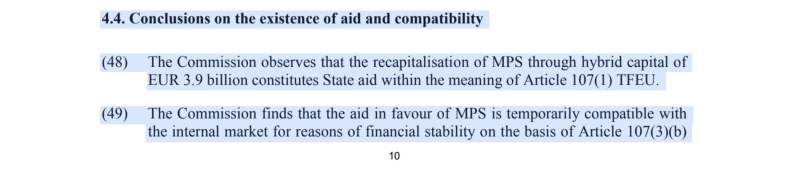
Above is Document C(2012) 9660, plus highlights regarding compatibility with State Aid based on Article 107(3)(b).
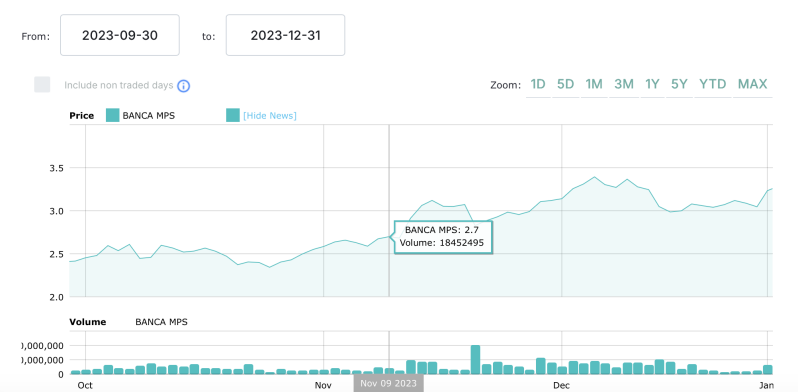
MPS share price development between September and December 2023.

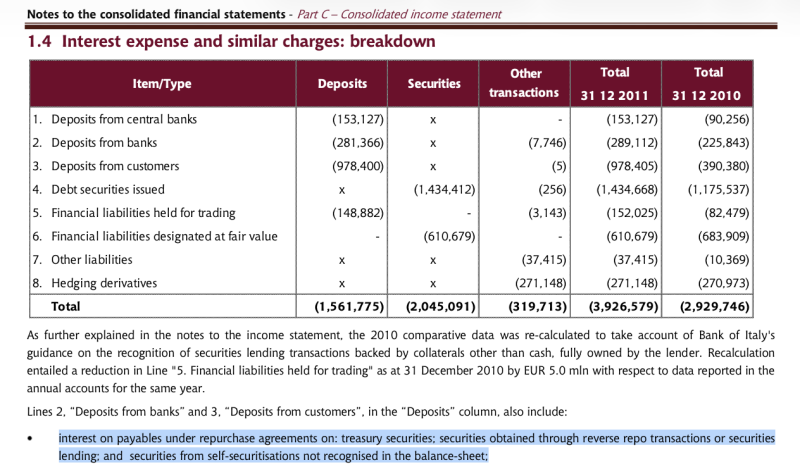
Respectively p. 95 and p. 248 of the 2011 Annual Report of MPS can be seen above.
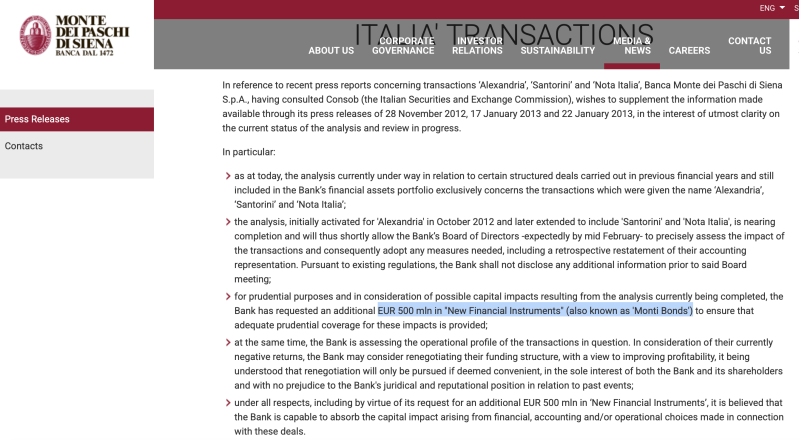
Press release on Monti Bonds by MPS, see above.
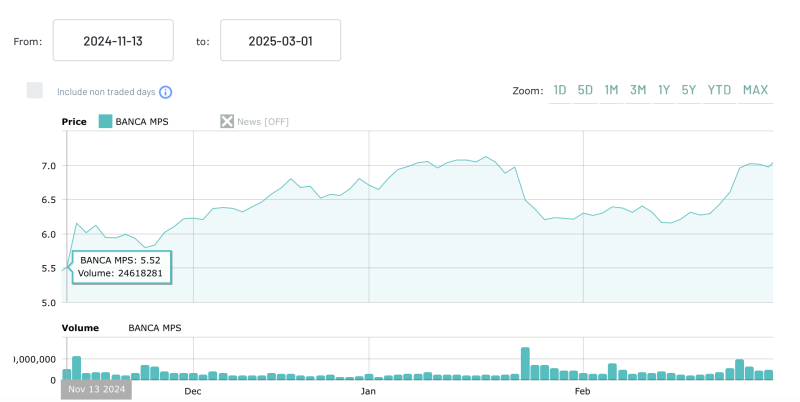
MPS share price development between November 2024 and March 2025.
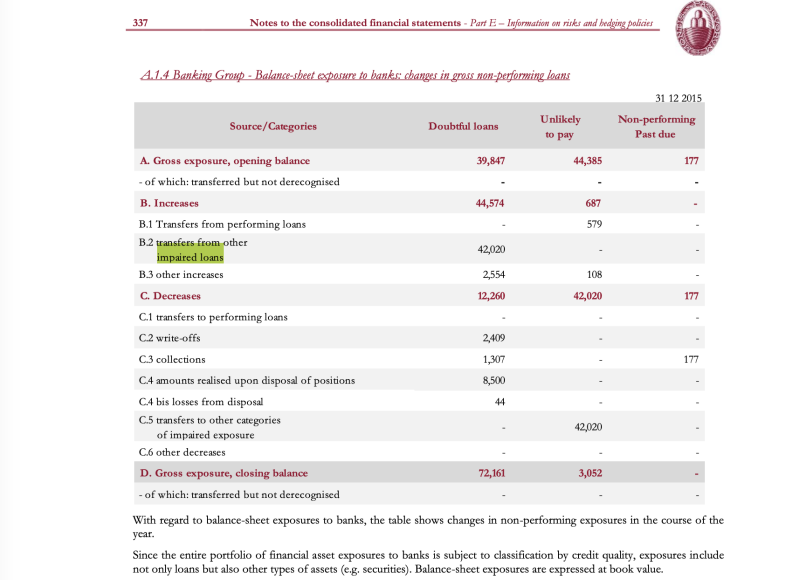
Above excerpt of the 2015 Annual Report page 337 (Table A 1.4 - Balance sheet exposures to banks: changes in gross non-performing loans) shows a complete offset of Non-Performing Exposures at year-end and a more than 90% reduction in "unlikely to pay" exposures to a different category, namely "Doubtful loans."
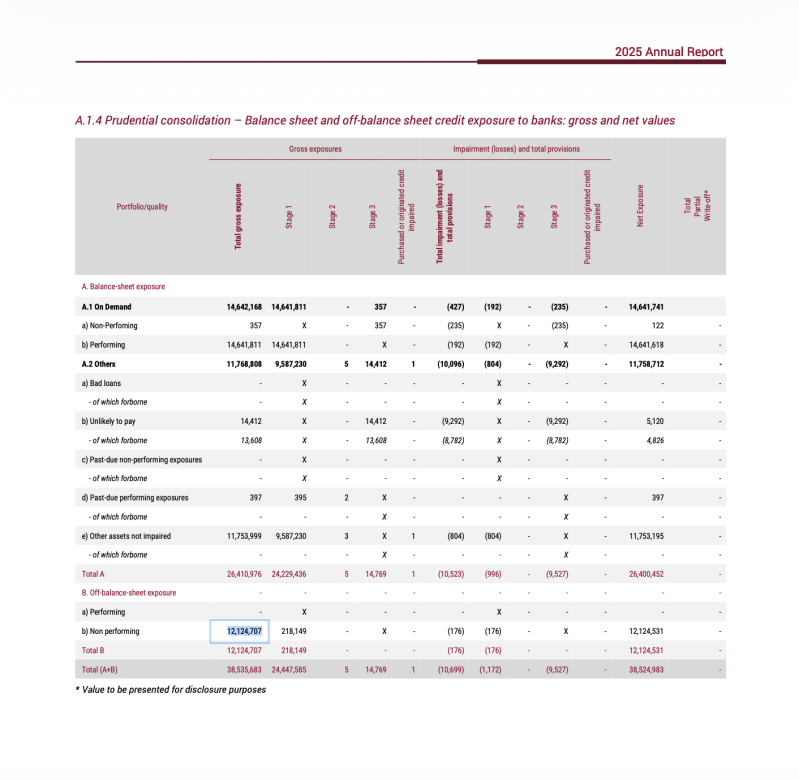
Above excerpt of the 2025 Annual Report page 622 shows Table A 1.4 for MPS in 2025. As visible, practically all Non-performing exposures with other banks have moved Off-Balance sheet (OBS).

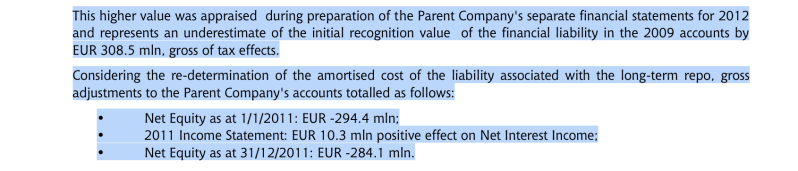
Above excerpt covers part of page 104 and 105 of the 2012 Annual Report of MPS, with reference to the Alexandria notes.
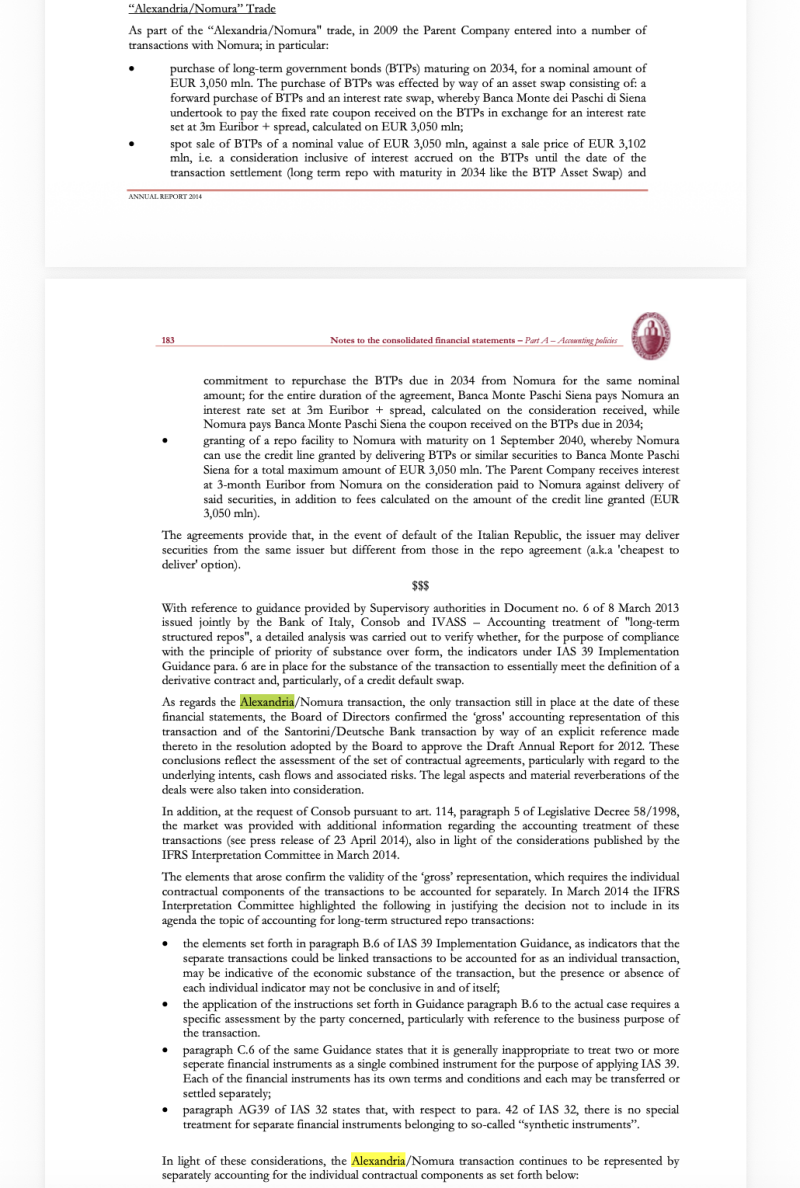
The 2014 Annual Report of MPS refers to the Alexandria and Santorini derivative deals, with several specifications given on p. 182 -183.
Insights from the two caveats, and question marks
The legal documentation regarding Money Laundering showed a responsive regulation regarding data protection versus availability, but the practical examples of three banks that escaped the radar demonstrate how Money Laundering can remain undetected, how credit ratings can be skewed, and what potential conflicts of interest look like and why they matter in relation to AML. It is hard to establish a counterfactual under 'normal market circumstances' for cases as large as e.g Parex, yet the resulting losses would have been less welcomed under normal market circumstances. The main question remains whether the bail-out saved costs compared to a normal market regime, versus burdens that have been shifted forward in terms of finance and human lives.
The case of Yorgen Fenech, although pending, illustrates how Money Laundering, organised crime and suspicions thereof permeates borders, institutions and liberalism itself. So did the illegitimate and suspicious activities of the three banks mentioned, i.e Parex, Pilatus and ABLV.
With regard to State Aid (this also applied to Parex), the government is equipped with instruments that would normally not be available on the market. This is in itself legitimate under certain circumstances, and accounts for market failures. At the same time, the case of the Monte Dei Paschi bail-out and subsequent sale of the mentioned 15% stake, poses questions as to whether State Aid can be abused when Systemically Important Financial Institutions are involved, who are sometimes large lenders towards the government, and in which the government in turn has a stake, a kind of revolving-door.
The bail-out of Parex is complex as both caveats in the Efficient Market Hypothesis apply to it to some degree. The three banks that largely slipped through the radar demonstrate how money laundering runs through different banks at the same time, establishing a correlation for moral hazard. What these cases and the trial involving Mr. Fenech show, is how criminal behaviour and economic vice affects both human dignity and the Efficient Market Hypothesis. This may seem a disgusting remark, but the underlying suggestion is clear: Protect those who are strong on both democracy and human rights, and improve the market. They need each other, especially for countries that have a mission to protect these two jointly (essentially every EU country). It is worth to honour those who have risked their life doing so, such as Daphne.
Besides the list on high-risk third countries, the situations discussed indicate some need for compiling a similar list for countries within the EU, and keep track of those responsible for its enforcement.
Conclusion
The efficient market hypothesis presents an ideal of what markets in equilibrium or search therein look like. Practice is different at times due to limits to human rationality and economic vice, and there are at least two important caveats that we could find, i.e Money Laundering and the usage of State Aid procedures and potential gaps in the legal instruments available. The direct effect of the caveats on the EMH is difficult to establish for both, yet by proxy we can infer that efficient markets have been distorted. And in the case of the illicit and suspicious funds documented, the market distortion reflects human suffering too. Externalities such as the ones described remain interesting topics for future research as they could help to approximate the ideal of money as a barometer of society's virtue.
Disclaimer: This article is investigative in nature and does not constitute investment advice. Claims in the article are made based on verifiable evidence or reasonable grounds, or sources that reference at least one of the two. The cases of State Aid and legal claims of Monte Dei Paschi are, as far as our observations show, completely independent from the Egrant inquiry and the cases of money-laundering and suspicious transactions at Parex, ABLV and Pilatus and should not be confused with each other.
The content of this article has no intention of providing a normative assessment (either positive or negative) regarding legitimate economic decisions, such as discussions on Mergers & Acquisitions involving Monte Dei Paschi.
Information regarding the case of Fenech has been collected to our best knowledge, yet it is not within the scope of this article to reach a definitive verdict on Mr. Fenech and the allegations brought forward.
Add comment
Comments