Disclaimer: This article does not constitute investment advice
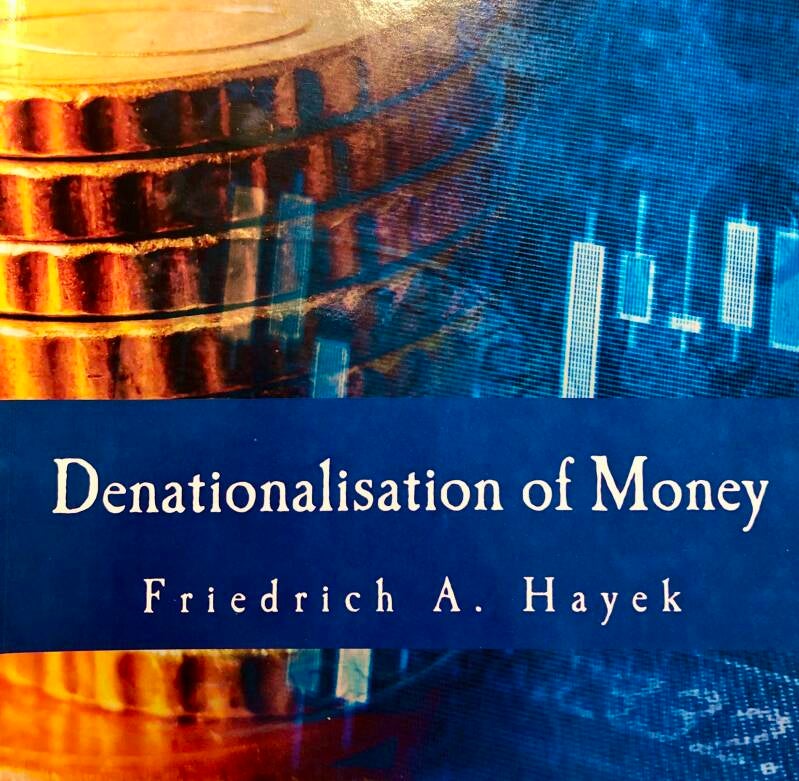
Denationalisation of money is book of about 130 pages written by Friedrich von Hayek in 1974. It discusses the role that government monopoly on money issuance has on the quality of currencies, and what alternatives there could be in the future. Hayek is among other economists a prominent proponent of monetarism, which holds that the government should set the money supply in the economy, so that the market can work towards the desired economic outcomes, emphasis added on the concept of Spontaneous Order. It means that you have an economy based on information dispersion through a natural process of discovery, under the assumption that society is too complex to rely on State planning, rather the market is called a 'Catallaxy', from the Greek word 'Katalasso'/to exchange. The book comprises of 25 parts, cites historical examples of private currency issuance under domestic government and coins a concept called Schwundgeld (shrinking money) and how to counter it. We have provided a summary in this article of (according to our knowledge) the most important insights of the book.
Disclaimer: We have not received any instruction or funds to promote Hayek, rather we have a genuine interest in his work and potential applications
This writing includes three Chapters, namely,
i) Summary of the book
ii) Separation of Money and State? Logical step after separation of Church and State or Utopian dream of a split reality?
iii) Questions and preliminary forecasts into potential scenarios
Summary
- In part I, "The Practical Proposal", Hayek opens with a warning on the introduction of a new European currency, under the assumption that it will only further entrench the root of all monetary evil: the government monopoly of the issue and control of money. Somewhat counterintuitive, he cites that governments have so far been unwilling to adopt the idea of denationalising their monopoly on money, and therefore will be even more reluctant to adopt such a common currency, essentially going a step further. This implies the Euro is not the opposite of the idea of denationalising money, but rather a more radical/advanced variant of it (it had not been introduced yet at the time of writing, yet discussions in doing so were ongoing, ultimately entrenching its adoption in through Member State convergence criteria in the 1992 Maastricht Treaty. Hayek says, "... in many respects a single international currency is not better but worse than a national currency if it is not better run." and mostly reasons from his own logic and first principles, little reference is made to other sources or economic analyses, and many phrases begin with " ... it seems to me ...", rather than "... research using A' or B's calculations has shown that ..." when discussing proposed outcomes. This is a caveat that requires support to make the assumptions meaningful.
The main argument for this denationalisation of money and introduction of a scheme of competing private currencies is given in Part II, "Preventing government from concealing depreciation.". Flaws and mismanagement in national currencies would be accounted for by the market and lead to a reallocation of resources without the need to establish a new international agency as would be required with a common currency. The need to generalise this principle of competing private currencies is emphasised, while acknowledging that 'the general public is not ready' for the idea of abolishing government control over money.
- Part III to V discusses the issuance of money by government. Due to the errors identified in Part I and II, there may be an initiative advantage of having government monopoly on mintage. This principle was well established by the Roman emperors and later on in the Middle Ages, this formed part of main sources of government income (under kings) called the Regalia (see p. 29), comprising of coinage, mining and custom duties. This gave the issuer also the task of determining weight of the metal and its purity.
Nowadays the equivalent of income on the exclusive right of coinage would be called Seignorage (Source: https://www.ecb.europa.eu/ecb-and-you/explainers/tell-me/html/seigniorage.en.html), which for example the European Central Bank receives. Hayek refers to this principle called valor impositus, which arose in the Middle Ages, roughly meaning the issuer determines the value. This led to ever decreasing amounts of (precious) metal involved in coinage, which basically leads to constant deterioration of money, which Hayek considers an abuse of government. Logically, when (precious) metal percentage become lower and lower, governments can supply (ever) increasing amounts of money, which they have done not only for the purpose of money market equilibrium, but also to cover deficits under the justification that it leads to employment. Hayek calls that notion into question, citing that is does not fall under the three duties of government according to Adam Smith (defence, justice, public works). Government money is justified on the basis of 'legal tender' as a means of legal certainty. Hayek then argues that this legal tender does not lead to certainty, citing the historical examples of legal tender cases before the US Supreme Court and monetary disputes arising after the First World War following years of inflation.
- Part VI to X covers analysis into the value of money and different types of money in circulation. Gresham's Law, that bad money tends to drive out good money, has been used as an argument for government monopoly over its supply. The idea of debtors choosing money with lower quantities of gold when paying off debts holds if law holds two kinds of money as perfect substitutes, when exchange rates are fixed.
In proposing a private system instead of a common commodity-backed system, he reasons that competition will control for value."People today trust that a bank, to preserve its business, will arrange its affairs so that it will at all times be able to exchange demand deposits for cash." (This was in 1973, before large-scale securitisation of mortgages took place in the 1980s, hence we hold that there are some caveats to this thinking, especially after the Global Financial Crisis of 2008).
He says the advance of such a system would depreciate national currencies. "The condition required in order that this displacement of the government money should terminate before it had entirely disappeared would be the government reformed and saw to it that the issue of its currency was regulated on the same principles as those of the competing private institutions." (the phrasing suggests that these private institutions abide by similar principles, and it again raises the question how individuals who report breaches in such a system can be effectively protected. Hayek does not mention that, but does highlight the importance of scrutiny by stock exchanges and the press.). A final problem is that there is not always a clear distinction between money versus non-money, rather it is said there is a continuum upon which objects of various degrees of liquidity can fluctuate independently of each other.
- Part XI - XV
Part XI and XII deal with the question of stability in the case of a competitive currency, with as core determinant expected value , which is largely based on public's desire to hold the currency. There are two main methods to alter volume:
i) buy/sell against other currencies (or securities/commodities) for quick/immediate action
ii) contract/expand lending activities for lasting effects
One question asked is whether parasitic currencies would prevent control of currency value? When an original issuer of a currency puts his brand into circulation, there is a chance that some other agent will replicate it. Existing legal protections may not prevent that, but the author stresses that this may not be desirable due to the similarities between these issued currencies, yet the original issuer should make clear (unlike governments) that it will not bail-out that second issuer. Hayek thinks that the public would choose from competing private issuers a better currency than provided by the government, while assuming that in a new situation, people will not at once act rationally. Four uses of currency are identified:
i) Cash purchases
ii) Holding reserves for future payments
iii) Standard of deferred payments
iv) A reliable unit of account

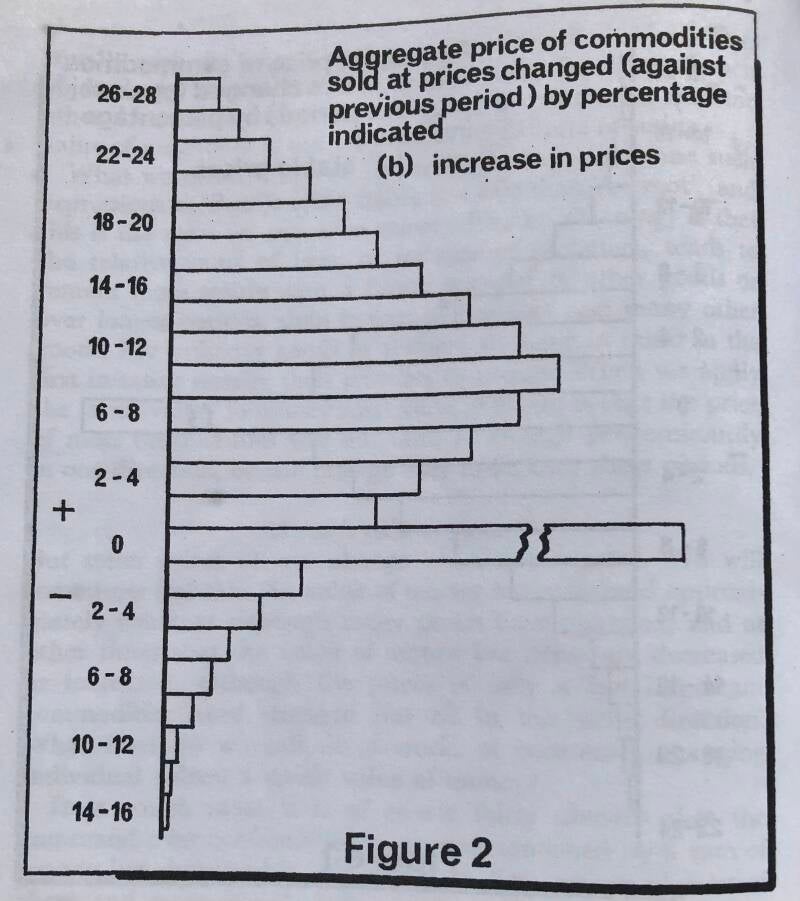
Stable value - in a perfect scientific sense - is said not to exist, instead value is constantly dependent on relationship/rate of equivalence. Given that the value of money can remain fairly stable despite constant price changes in the free market, and vice versa. It is noted that for the individual, future movement of most prices is unpredictable (p. 70), so the closest definition of a stable value of money can be found in protection against balancing/accounting errors (this is in a sense a via negativa approach). Two figures above describe the 'aggregate price of commodities sold at prices changed' for two scenarios: i) stable prices ii) increase in prices (excerpts from p. 71 and 72)
Regarding the importance of accounting, under conventional government currency issuance, so-called Quantity theory plays an important role. This theory is defined by Hayek as follows: "The quantity theory of money presupposes, of course, that there is only one kind of money in circulation within a given territory, the quantity of which can be ascertained by counting its homogeneous units". In the case of denationalisation this no longer holds, and neither do the usual assumptions of monetary theory (one currency, no sharp distinction between this currency and substitutes). The cash balance approach and the concept of velocity of circulation is opted for instead.
This leads to the concept of monetarism, which holds that 'inflationary or deflationary movements are accompanied by changes in the quantity of money and velocity of circulation' (this can be derived from page 79). Hayek holds the following stance on monetarism, according to page 81: "Monetary management cannot aim at a particular predetermined volume of circulation, not even in the case of a territorial monopolist of issue, and still less in the case of competing issues, but only at finding out what quantity will keep prices constant." If a predetermined volume of circulation is even harder to determine in the case of competing currencies, we then wonder how price stability is achieved in such a scenario. Hayek notes that when deciding how much quantity of the currency to keep in circulation, willingness to hold is more important than demand for borrowing. Hence increasing the value individuals can hold satisfies part of the demand for increased liquidity. No precise answer is given on how to achieve price stability based on monetarist insight, other than a hint to keeping the average prices of 'original factors of production' constant (p. 88).
- Part XVI- XX
In part XVI, Free banking is discussed. It is defined as the demand for the free issue of bank notes. In the case of Germany and France, it is said, the discussion dealt with commercial banks' legitimacy to issue notes in terms of established national currency (p. 90) The moment banks became fully responsible for notes no longer redeemable into gold or silver, the argument for free banking was largely put to an end in favour of a centralised currency. A discussed problem in case of denationalisation is that the capacity for bail-out by a central bank disappears, and that the need for overhauling conventional banking practices will be an important cause for opposition by established interests.
Under normal circumstances, no general increase or decrease of prices is expected, provided that appropriate adjustments of quantity can be controlled for. Yet the problem of sticky prices and wages remain. Hayek insists that under his proposed scheme, 'general deflation will be as impossible as general inflation'. But then again monetary policy under a central bank would then be impossible, and as he says, unnecessary, for the profit-driven incentives of private issuers will suffice to optimise the supply of the competing currencies. It would thus ultimately be accompanied by the abolition of central banks.
The usage of central banks as a lender of last resort or 'holder of ultimate reserve' is then attributed to the fact that commercial banks currently rely on these guarantees to back up their claims on provided cash.
What we keep wondering is how scalable this idea is. Until what scale does such a private scheme not cause instability but rather prove more effective at preserving it (if it does so?)
Hayek continues with the finding that 'a fixed rate in redemption of gold or some other currency' thus far provided the only disciplinary effect on money's value, though it is too weak a discipline to avoid government from breaking it (p. 109).
Secondly, gold is described as a 'wobbly anchor' at best, since its reliability is determined by the degree to which currencies can be converted into it, dating from a time in which all currencies were metallic. Instead, it is argued that free enterprise is a much better anchor than government or gold will ever be. (It must be said that few examples are given, oftentimes the author says 'I believe' in relation to free enterprise. One should be careful that it does not take on a somewhat religious undertone.) The most important given argument for this is that government money/fiat money is 'accepted' by force, whereas private currencies issued in a competitive setting derive their value from scarcity and the fact that other individuals also value it as a result.
A remaining problem is that of wage rigidity, and governments are reported to have solved this issue in the past by raising national price levels, (which requires a monetary expansion). Hayek argues this deprives trade unions of their responsibilities, he calls it monetary nationalism (p. 115). (This would be offset by a depreciation in the exchange rate versus other currencies. At the same time, he opposes the idea of making national currencies convertible to each other at a fixed exchange rate (this is effectively what the Euro has done). Instead he wants to end all such frontiers. Part XX concludes that national price stability is in fact not necessary if there is a large interconnection of commodity streams, and can even disrupt economic activity as it may actively distort natural supply and demand functions in the economy.
- Part XXI - XXV discusses the implementation of a denationalisation scheme, a transition period, and its influence on government finances and protection against the State. The combination of monetary and fiscal policy is said to be problematic, negatively affecting each other. Besides the accusation that it has made money 'chief cause of economic fluctuations' (p. 117) and increasing public expenditure, no exact explanation is provided. It is stressed that political control over a central bank hampers effective monetary policy (in this sense, the ECB and its mandate may have drawn upon this logic as the institution enjoys a high degree of independence from politics). Hayek goes a step further, saying that this is impossible under a democratic government dependent on special interests, in contrast to a 'benevolent dictator' (proportions matter, after all, when is a dictator a benevolent dictator?), for government's monopoly over money removes constraints on moderating its expenditures, resulting in unbalanced budgets.
This considered, government power facilitates centralisation. Hayek warns on an ever-increasing share in the economy that government has, which can become totalitarian (he has written another book before named 'Road to Serfdom' in which this problem is explored in more detail). Thus to him, government should be deprived of its monopoly over money.
During a transition towards the proposed scheme, rapid depreciation of formerly exclusive currency is mentioned as a risk to contain, citing a rapid expected depreciation of the existing currency by new competing ones. How to contain the risks of this transition is not very well-specified. Instead, government is advised to regulate currency in precisely the same manner as new issue banks do, and 'concede all required liberties'. In other words, the transition would be immediate, not gradual.
Hayek cites that people 'would learn to trust the new money only if they were confident it is completely exempt from any government control' (p. 122). Expected risk against which the denationalisation scheme would have to protect itself, under the umbrella of government interference, are attempts to reintroduce a national currency.
The long-run effects, Hayek argues, are hard to predict, yet he expects more stable rates of exchange than today, but still less than when based on a gold standard. And the final point he makes is that the abolition of government control over money, would require a new legal framework that is still hard to implement in international law.
Our impression is, that Hayek's proposed scheme in its most radical form, calls for a kind of Monetary Reset on a grand scale.
In addition
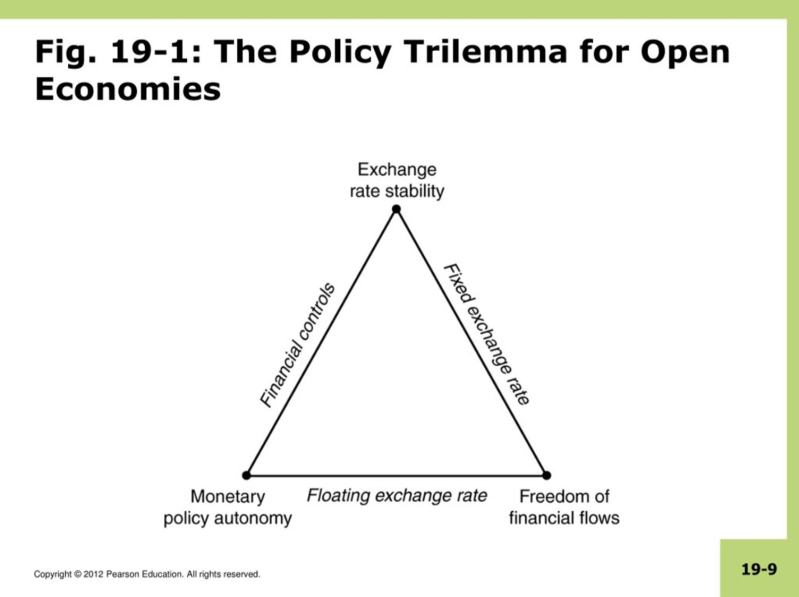
As a point of clarification, we have included the impossible trinity regarding monetary policy, see picture below. The logic behind it is as follows:
- When you have a Fixed exchange rate and Monetary policy autonomy, the Free flow of capital will have to be constrained
- When you have Free flow of capital and Fixed exchange rate, Monetary policy is no longer autonomous
- When you have a Free flow of capital and Monetary policy Autonomy, you cannot have a Fixed exchange rate
The figure is a bit misleading, as free flow of capital and monetary policy autonomy can still uphold a stable exchange rate, but it will not be fixed (as in the case of the Euro).
Some people say that Mr. Hayek predicted the rise of Bitcoin as early as 1984. Likely, these people refer to the following video:https://www.youtube.com/watch?v=nswOYo0zUcI which can be found above at the top of this article.
Do we see a gradual denationalisation of money in the Eurozone?
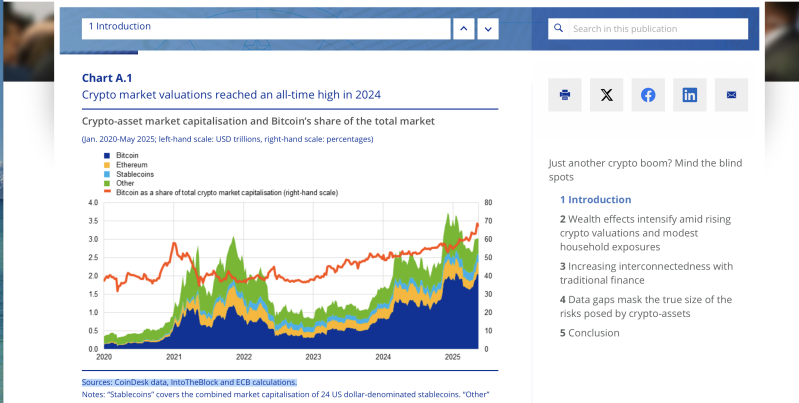
Especially since the aftermath of the COVID pandemic, the issuance of private cryptocurrencies has become more widespread as visible on chart A.1 of this 2025 ECB announcement. With early cryptos such as Bitcoin and Ethereum, many competitors have now followed, which operate beyond borders and sometimes attempt to operate beyond the reach of governments.
So far, the issuance of private currencies in the Eurozone has been strictly limited, several legal requirements have to be met. The Markets in Crypto Assets Regulation /MiCar is among the most important of these, the first version of which can be found on the right below (OJ L 150, 9.6.2023, pp. 40–205). Before that, EMIR already contained reporting requirements for Crypto Derivatives (Source: https://finance.ec.europa.eu/financial-markets/financial-markets-policy/post-trade-services/derivatives-emir_en). So there is possibility to issue private currencies in the Euro area, but not unconditionally: the Euro as such has to stay intact. The chart on the right shows that in 2026, a market capitalisation of $3 trillion has been hit, according to calculations referred to by the ECB, see chart A.1 again.
ii) Separation of Money and State? Logical step after separation of Church and State or Utopian dream of a split reality?
There is some overlap between the idea of denationalisation of money and a separation between Money and State. In the case of separation between Money and State, the government completely abandons its intervention in the money market, which then becomes autonomous. It then of course loses its monopoly on government currency, in fact it loses then all its monetary functions. This proposition has support in certain libertarian circles, as well as by 'Anarchocapitalists'. Though it is not exactly the same as a free market with no State (the State continues to exist but for other functions such as courts, police and national defence), it could technically pave the way for it.
iii) Questions and preliminary forecasts into potential scenarios
Question marks
A question that we pose is whether or not a privatisation of currencies in fact leads to a few winners who then take control of the general rules involving monetary transactions, such as a full digitalisation, leading then to an outcome similar to a case in which the government uses its monopoly over currency to enforce full digitalisation.
Secondly, when money is to be the barometer of a society's virtue, we wonder which currency is going to serve as an objective barometer when all currencies are privatised? Is is the one with the highest market value? Does that flip back and forth between different currencies? If the answer to the last question is yes, then who is going to ensure that the estimates of value do not become a very volatile, thereby fostering rent-extraction? Should there not be an independent authority to verify its value and for example, prevent money-laundering? It is not unthinkable that a currency which also captures black markets will gain a higher standing in the economy due to increased share in the marketplace, so long as money-laundering cannot be proven.
Thirdly, on what scale can this denationalisation process succeed? Will it be achievable by a small community of nations, or globally, or only in countries with a federal setup? Or else?
And last but not least, is it really more radical to have a common currency than a denationalisation as Hayek proposed? Or is there in fact overlap possible? It seems there is an incentive for the Euro, derived from the Greek word 'eurys' (wide), to broaden its spectre.
It also pays to watch out for a scenario in which denationalisation leads to a 'derealisation' of money, i.e a situation where money no longer resembles real economic value.
Potential scenarios?
We thus reach a (somewhat premature) conclusion that there are three main scenarios possible regarding the EU:
- A denationalisation process in which the Euro, besides the general currency, acts as a barometer for the value of private currencies. The Euro can only act as such a barometer to the extent that it is a pure currency, hence based on objectivity and as little corruption as possible, or political interference. If there is a lot of corruption, money laundering and inflation involved in the Eurosystem, private currency issuers will have an incentive to resort to a different 'baseline currency'.
- A denationalisation process in which a race to the bottom in competitive terms will then again lead to a winning currency with less objective checks and balances, risking destabilisation and subsequent reliance on at least one national currency of some country (no man is an island after all). This can be seen by recent attempts to introduce a form of 'anarcho-capitalism' such as in Argentina with the election of Milei (https://mises.org/mises-wire/nine-months-javier-milei-president-argentina-critical-assessment). He put heavy emphasis on Cryptocurrencies and other private moneys. In the end, the central bank maintains its position and pegs the pesos to the US dollar, having been warned by economists about the risks of instability that could arise in a free market with no State. In fact, the Money Supply, M1, has increased according to the articles by Mises Institute. This makes the USD an important reference currency for private currencies.
- A denationalisation process in which no clear reliance on some baseline currency is put through, leaving it largely up to the market which currencies to issue, as long as compatible with the law. Without clear rules of engagement, this could cause instability (no man is an island), unfair competition, and may even lead to demand for renewed issuance of a national currency, essentially turning back the clock in the EU. Such movements are not unthinkable, after Brexit has been put through. Since the Euro is there, it cannot be 'thought away'. But when individuals really try to find a 'sneaky' roundabout way, they might try to do as they please and not clearly resort to a common currency for measurement, embracing maximum volatility instead, i.e having a currency that thrives on chaos may in fact make it a valuable one in times of chaos..
And last but not least, is it really more radical to have a common currency like the Euro than a denationalisation as Hayek originally proposed? Or could it be in fact a more moderate alternative that could complement his idea of private currency?
To be explored ...
Add comment
Comments