Economics tries to understand human interaction in society, markets in particular, through available data and modelling thereof.
This frequently means that both insights from positive sciences (statistics, mathematics) are combined with normative/social sciences in which morally charged claims regarding situations are made, i.e right versus wrong.
Early attempts at economic modelling and forecasting include futures and derivatives on olives in Ancient Greece for example (Source: https://www.mudem.it/approfondimenti/talete-i-frantoi-di-mileto-e-i-prodotti-derivati?com.dotmarketing.htmlpage.language=1). In the twentieth century, classical economic theory has experienced a kind of revival through neoclassical economics with market efficiency as a core theme, as well as deviations thereof (see our earlier article 'Money as the barometer of society's virtue and vice). In this context, the efficient market hypothesis plays an important role and basically assumes that all information available in the economy is efficiently dispersed through the markets, so that each individual has the right information to make rational decisions, leading to equilibrium. Quite an ideal, yet is it realistic?
In a perfectly efficient market, there is no room for an error term as all values have been fully reflected in the price. Based on previous research, we conclude that this is not always the case (see our earlier article 'Money as the barometer of society's virtue and vice), hence the error term does matter.
In econometrics, the error term has been defined as follows in a 1990 paper by Jan Tinbergen (Tinbergen, J. (1990). The Specification of Error Terms. In: Velupillai, K. (eds) Nonlinear and Multisectoral Macrodynamics. Palgrave Macmillan, London. https://doi.org/10.1007/978-1-349-10612-7_13):
- The error term is a catchall for less important independent variables and for measuring errors of both the dependent and independent variables.
- It is as a standard assumed to be a random variable with a mean of zero and a normal distribution
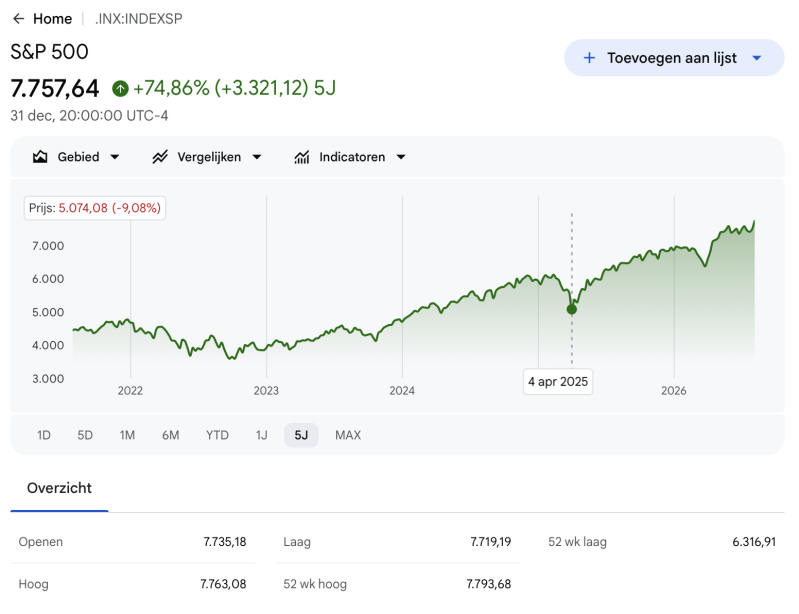
An interesting feature of the error term is its potential to deviate from the expected mean (of zero). Previous literature has shown how black swans can hide in the invisible parts of a model/statistical distribution. An interesting case of a recent black swan was a record one-day drop of the S&P 500 index of 3 April 2025. The main cited reason for this drop was the announcement of Import Tariffs by US president Trump on 2 April 2025, which comprised twice the value of the highest tax increase in modern US history, with a targeted revenue of 500 billion USD (Source: https://www.bairdwealth.com/insights/market-insights/baird-market-strategy/2025/04/in-the-markets-now-selloff-summary-for-april-3/). Why is it a black swan? classified as a 9-sigma event, or 9 standard-deviations from the mean event, dropping around 4.8% according to some sources. The above picture indicates a drop of -9.08% in a week, towards 5,074 Dollars.
The answer is as follows. A black swan is defined as an event that is hard to predict in advance, and has massive consequences.
Black swans fall within a range that is beyond six standard deviations from the mean of a statistical distribution, in case of a market crash the drop is thus more severe than six standard deviations from the mean (Source: https://www.britannica.com/topic/black-swan-event). The drop of 3 April 2025 was. classified as a 9-sigma event, or 9 standard-deviations from the mean event, dropping around 4.8% according to some sources. The above picture indicates a drop of -9.08% in a week, towards 5,074 Dollars. It thus exceeds the threshold of 6 standard deviations.
Two other questions come to mind with this event:
- Can it be expected based on economic modelling/forecasting?
- If it falls under the scope of the error term, does the outcome result out of the omission of variables?
Regarding the first question, we have concluded that the event of 3 April 2025 is a black swan. By that definition, it is not expected based on existing economic modelling/forecasting.
Regarding the second question, if it does not fall within the forecast of a model's parameters, it automatically falls under the scope of the error term. Whether or not it is the result of an omitted variable is hard to establish on the basis of one event. If a drop of similar magnitude occurs more often, repeated regression may indicate a variable has been omitted.
On a cautionary note, we should not confuse error term with the concept of Black Swan as if they are interchangeable. Instead, the error term is used to capture residual data and scrap data, this might include black swans or clues for future ones.
The more the risks of black swans can be contained, the more reliable economic modelling becomes. The key is in the acknowledgement of a model's limitations.
Add comment
Comments