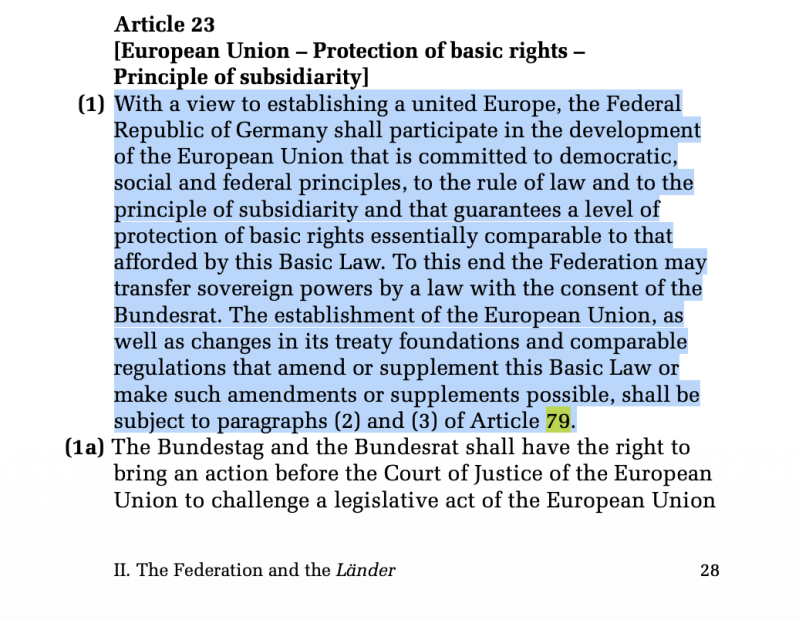
The establishment of the European Union has had a strong correlation with developments in the German Basic Law that has been in place since 1949. The first notes on the European Union. The most recent version we could find dates to 22 March 2025 and covers the 21st electoral term. It can be found over here:
www.btg-bestellservice.de/pdf/80201000.pdf
As evident from the document's front page, the Basic Law was adopted on 23 May 1949, shortly after the establishment of NATO and the Council of Europe.
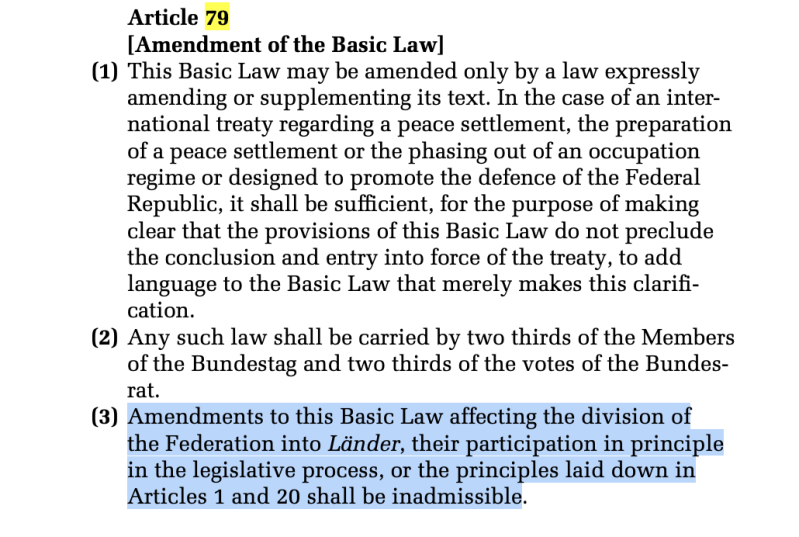
Article 79(3), also called the Eternity Clause can be found at the section 'Legal Foundations' on page 65 of the document. It requires more clarification in relation the powers of not only the German State, but the European Union and European Central Bank as well, and their room for manoeuvre.
The full definition of Article 79(3) is as follows: "Amendments to this Basic Law affecting the division of the Federation into Länder, their participation in principle in the legislative process, or the principles laid down in Articles 1 and 20 shall be inadmissible."
Article 1 of the German Basic Law of Germany holds the following:
"[Human dignity – Human rights – Legally binding force
of basic rights]
(1) Human dignity shall be inviolable. To respect and protect it shall be the duty of all state authority.
(2) The German people therefore acknowledge inviolable and inalienable human rights as the basis of every community, of peace and of justice in the world.
(3) The following basic rights shall bind the legislature, the executive and the judiciary as directly applicable law."
Article 20 holds that:
"[Constitutional principles – Right of resistance]
(1) The Federal Republic of Germany is a democratic and social federal state.
(2) All state authority is derived from the people. It shall be exercised by the people through elections and other votes and through specific legislative, executive and judicial bodies.
(3) The legislature shall be bound by the constitutional order, the executive and the judiciary by law and justice.
(4) All Germans shall have the right to resist any person seeking to abolish this constitutional order if no other remedy is available."
We interpret title (4) of Article 20 as an important logical justification to combat illiberalism from the perspective of German Law as well as the jurisdictions governing the other EU Member States. At the same time, it should be borne in mind that non-compliance with Article 18 may lead to forfeiture of Basic Rights:
"Article 18
[Forfeiture of basic rights]
Whoever abuses the freedom of expression, in particular the freedom of the press (paragraph (1) of Article 5), the freedom of teaching (paragraph (3) of Article 5), the freedom of assembly (Article 8), the freedom of association (Article 9), the privacy of correspondence, posts and telecommunications (Article 10), the rights of property (Article 14) or the right of asylum (Article 16a) in order to combat the free democratic basic order shall forfeit these basic rights. This forfeiture and its extent shall be declared by the Federal Constitutional Court."
Hence human dignity is protected by the Eternity Clause, as is the democratic State, and the right of resistance towards persons who attempt to destroy the constitutional setup. A question in this context is whether it is possible to establish legal emergency measures around Article 79(3) on the basis of Article 20(4) of the German Basic Law while respecting the constraints of Article 18.
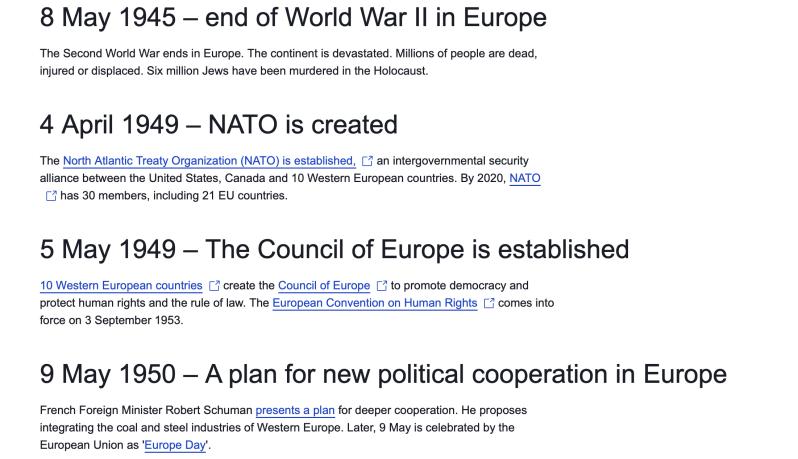
On 9 May 1950 (see timeline), "A plan for new political cooperation in Europe was set up", paving the way for the establishment of the European Union. The Council drew a high degree of inspiration from a speech given by former British Prime Minister Winston Churchill in Zurich in 1946, which called for peaceful cooperation in Europe (https://www.ebsco.com/research-starters/law/council-europe).
As evident from the timeline, in 1950 the Schuman plan was presented to put the ambition of this cooperation into economic practice, starting with integration of the steel and coal community, approved upon by the following countries: The Netherlands, Belgium, Germany, France, Italy and Luxembourg. (https://european-union.europa.eu/principles-countries-history/history-eu/1945-59/schuman-declaration-may-1950_en). This paved the way for further European integration with the Maastricht Treaty of 1992 and the Lisbon Treaty of 2009.
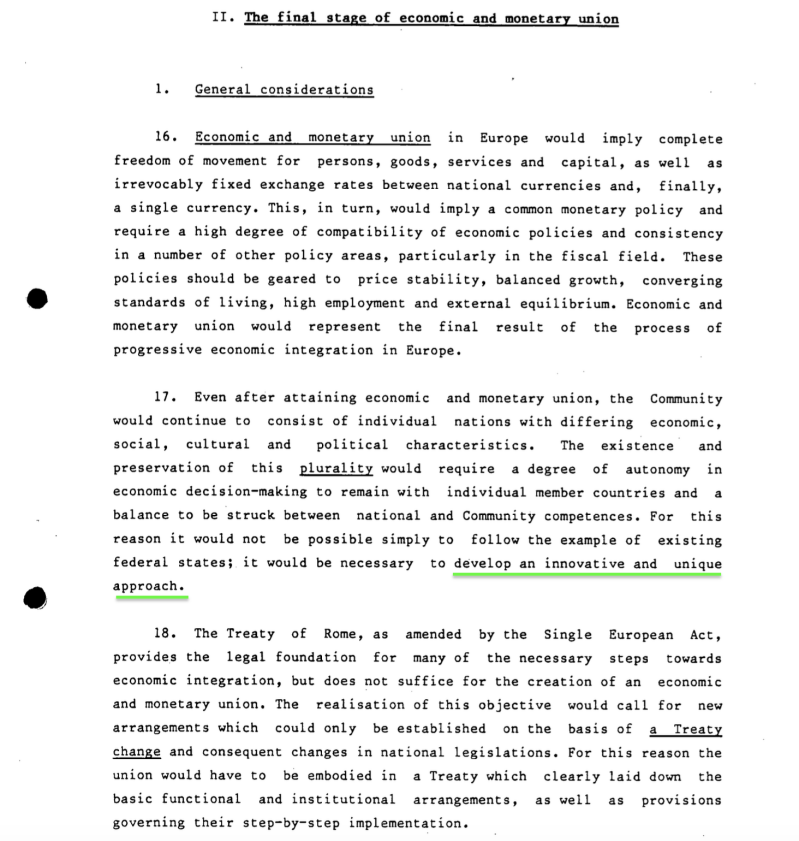
The Report on Economic and Monetary Union in the European Community of 12 April 1989 sets out the achievements of the European Monetary System up to that point (submitted by the Committee for the Study of Economic and Monetary Union).
The EMS was launched in 1979 (see page 1 of the report), following the initiation of the European Monetary Co-operation Fund of 1973, which resulted out of a desire to form a common economic and monetary union, discussed as early as the 1960s.
An important barrier in this integration, mentioned in the report, relates to divergences between national fiscal policies, differing economic growth paths and capital controls. The Report by Jacques Delors cites that a 'unique' approach is necessary. What exactly that unique approach is remains a bit blurred, but it is clear that there has to be a single fixed exchange rate and the four famous freedoms for movement need to be enshrined, regarding:
i) Persons
ii) Goods
iii) Services
iv) Capital
We would add, as a sidenote, that constraints on the free travel of persons who report breaches in the law, are an arbitrary constraint imposed on Persons. The withheld knowledge of these persons may also restrict the freedom of one or more of the other three factors.
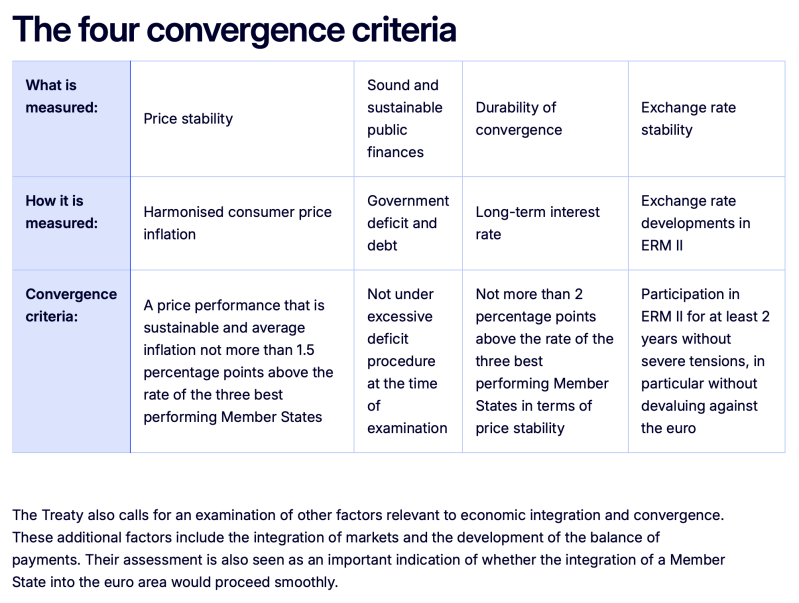
The Maastricht Treaty was one of the more concrete steps at genuinely putting the attempt of establishing a common currency in practice. Since then, the following four convergence criteria had to be upheld if a Member State was to adopt the Euro:
- Price Stability
- Sound and sustainable public finances
- Durability of convergence
- Exchange rate stability
Having met these convergence criteria, there are currently 21 EU Member States which have adopted the Euro as their currency. (https://european-union.europa.eu/institutions-law-budget/euro/countries-using-euro_en).
Yet what does the Eternity Clause have to do with the Euro?
The answer: Everything
This article explains why that is the case through the lens of two of von Hayek's works:
These are, chronologically ranked, the Road to Serfdom - released in 1944 - and the Constitution of Liberty - released in 1960. Below we give an overview of the main takeaways of the two, and implications for the EU and the Euro.
Yet what does the Eternity Clause have to do with the Euro?
Our hypothesis: Everything
This article explains why that is the case through the lens of two of von Hayek's works:
These are, chronologically ranked, the Road to Serfdom - released in 1944 - and the Constitution of Liberty - released in 1960. Below we give an overview of the main takeaways of the two, and implications for the EU and the Euro. We have provided a summary of both, followed by a comparison of their relevance for EU law and the Euro. The method of summarisation is as follows: We have captured for each chapter a quote that, according to us, contains an important insight from the chapter. This selection involves a degree of spontaneity. We like to stress that the quotes are Hayek's, not ours. A comparison of the most important insights is provided afterwards.
There may be those who disagree with our hypothesis. Why not just any other legal clause/provision? We think this clause is relevant because it protects those aspects of the law that are compatible with eternal/natural law.
I. The Road to Serfdom (1944) (Comprising of 16 Chapters)
The Road to Serfdom is one of the first books written by Von Hayek on economic policies involving Socialist governments as well as that of the Nazis. Released in 1944, it was a controversial work as it criticised socialists who simultaneously faced brutal persecution by the Nazis. Yet the Nazis receive in fact even heavier criticism. A distinction is made between 'design' and 'laissez-faire' conditions in the economy. Design simply means respect for Rule of Law to uphold a level playing field, whereas laissez-faire suggests complete State withdrawal. In contrast, central planning could be undertaken by parties on the right as well as the left (introduction, p.17).
Chapter I. The Abandoned Road
"But the essential features of that individualism which, from elements provided by Christianity and the philosophy of classical antiquity, was first fully developed during the Renaissance and has since grown and spread into what we know as Western civilisation - are the respect for the individual man qua man, that is, the recognition of his own views and tastes as supreme in his own sphere, however narrowly that may be circumscribed, and the belief that it is desirable that men should develop their own individual gifts and bents." (p. 68)
Chapter II. The Great Utopia
"The extraordinary thing is that the same socialism that was not only early recognised as a reaction against the liberalism of the French Revolution, gained general acceptance under the flag of liberty." (p. 76)
Chapter III. Individualism and Collectivism
"The dispute between the modern planners and their opponents is, therefore, not a dispute on whether we ought to choose intelligently between the various possible organizations of society; it is not a dispute on whether we ought to employ foresight and systematic thinking in planning our common affairs. It is a dispute about what is the best way of so doing. The question is whether for this purpose it is better whether the holder of coercive power should confine himself in general to creating conditions under which the knowledge and initiative of individuals are given the best scope so that they can plan most successfully; or whether a rational utilization of our resources requires central direction and organisation of all our activities according to some consciously constructed 'blueprint'." (p. 85)
Chapter IV. The "Inevitability" of Planning
"And because all the details of the changes constantly affecting the conditions of demand and supply of the different commodities can never be fully known, or quickly enough be disseminated, by any one center, what is required is some apparatus of registration which automatically records all the relevant effects of individual actions and whose indications are at the same time the resultant of, and the guide for, all the individual decisions. This is precisely what the price system does under competition, and which no other system even promises to accomplish." (p. 95)
Chapter V. Planning and Democracy
"It is not difficult to see what must be the consequences when democracy embarks upon a course of planning which in its execution requires more agreement than in fact exists. The people may have agreed on adopting a system of directed economy because they have been convinced that it will produce great prosperity. In the discussions leading to the decision, the goal of planning will have been described by some such term as "common welfare", which only conceals the absence of real agreement on the ends of planning." (p. 103/104)
Chapter VI. Planning and the Rule of Law
"While every law restricts freedom to some extent by altering the means which people may use in the pursuit of their aims, under the Rule of Law the government is prevented from stultifying individual efforts by ad hoc action." (p. 112)
Chapter VII. Economic Control and Totalitarianism
"To be controlled in our economic pursuits means to be always controlled unless we declare our specific purpose. Or, since when we declare our specific we shall also have to get it approved, we should really be controlled in everything." (p. 126)
Chapter VIII. Who, Whom?
"There is, indeed a strong case for reducing this inequality of opportunity as far congenital differences permit and as it is possible to do so without destroying the impersonal character of the process by which everybody has to take his chance and no person's view about what is right and desirable overrules that of others." (p. 134)
Chapter IX. Security and Freedom
"It will be well to contrast at the outset the two kinds of security: the limited one, which can be achieved for all, and which is therefore no privilege but a legitimate object of desire; and absolute security; which in a free society cannot be achieved for all and which ought not to be given as a privilege -- except in a few special instances such as that of the judges, where complete independence is of paramount importance." (p. 147)
Chapter X. Why the Worst Get on Top
"The principle that the end justifies the means is in individualist ethics regarded as the denial of all morals. In collectivist ethics it becomes necessarily the supreme rule; there is literally nothing which the consistent collectivist must not be prepared to do if it serves "the good of the whole", because "the good of the whole" is to him the only criterion of what ought to be done. (p. 166)
Chapter XI. The End of Truth
"Few traits of totalitarian regimes are at the same time so confusing to the superficial observer and yet so characteristic of the whole intellectual climate as the complete perversion of language, the change of meaning of the words by which the ideals of the new regimes are expressed." (p. 174)
Chapter XII. The Socialist Roots of Naziism
"It was the union of the anticapitalist forces of the Right and of the Left, the fusion of radical and conservative socialism, which drove out from Germany everything that was liberal." (p. 182)
Chapter XIII. The Totalitarians in Our Midst
"Apart from the intellectual influences which we have illustrated by two instances, the impetus of the movement toward totalitarianism comes mainly from the two great vested interests: organized capital and organized labor. Probably the greatest menace of all is the fact that the policies of these two most powerful groups point in the same direction." (p. 204)
To some extent this contradicts the earlier notion that it is mostly socialism on the Left and Right that opposes liberalism and capitalism. A question would thus be whether or not Hayek considers organised capital a form of socialism.
Chapter XIV. Material Conditions and Ideal Ends
"When we consider the claims for social reconstruction which are most strongly pressed, it appears that they are almost all economic in character: we have seen already that the "reinterpretation in economic terms" of the political ideals of the past, of liberty, equality and security, is one of the main demands of people who at the same time proclaim the end of economic man." (p. 210)
We wonder to what extent the economic man reflects man accurately, and how this rhymes with Hayek's later analysis of for example Chile, since the reconstruction of society that took place between 1973-1990 was largely economic in character. Could he have missed his own point?
Chapter XV. The Prospects of International Order
"While for its task of enforcing the common law the supranational authority must be very powerful, its constitution must at the same time be so designed that it prevents the international as well as the national authorities from becoming tyrannical. We shall never prevent the abuse of power if we are not prepared to limit power in a way which occasionally may also prevent its use for desirable purposes." (p. 235)
We think this quote captures best the reasoning of Article 79 (3) of the German Basic Law as a limitation on the powers of the EU and the ECB, while simultaneously delineating strict boundaries by which both the German State and the individual under the German State should abide.
Chapter XVI. Conclusion
"The guiding principle that a policy of freedom for the individual is the only truly progressive policy remains as true today as it was in the nineteenth century." (p. 238)
Comparison of insights from both books
The quotations from Road to Serfdom show that Hayek has a clear aversion to social planning in the economy. The reference to the Nazis as being an extension of socialism remains controversial, for socialists and marxists were among the first to be prosecuted under the Nazis. Socialism is mostly defined in the book as a reaction against liberalism and the individual.
The fact that Hayek rejects the idea of 'the end justifies the means' implies that he has some conception of absolute good versus evil. Chapter 11 (the End of Truth) essentially equates liberalism with the individual grounded in reality versus an illiberal totalitarian society, with the perversion of language as a first step. Though we agree, we remain somewhat careful in directly linking this to attempts of economic intervention. Although Hayek shows a distaste for Social Justice, one should be careful not to dismiss social justice as illiberal, as it highlights desired changes that may very well be compatible with Rule of Law. Logically then, social justice can be pursued without paving a Road to Serfdom.
The findings in Chapter 13 (the Totalitarians in Our Midst) with the notion that organised labor and organised capital, seems somewhat contradictory to the earlier observation that socialism on the Left and Right are the main threat to freedom. A question would thus be whether or not Hayek considers organised capital a form of socialism.
Likewise, the welfare state is reluctantly painted as the successor to socialist ideals in a more law-abiding way than old-fashioned socialism. But the same could be said about bail-outs to large banks through Quantitative Easing and other 'socialism through the back-door' policies that favour powerful corporations. We therefore wonder if the idea of "Decline of the law" holds, to what extent and if it is reversible.
Regarding the remarks on social reconstruction in Chapter 14, we wonder to what extent the economic man reflects man accurately, and how this rhymes with Hayek's later analysis of for example Chile, since the reconstruction of society that took place between 1973-1990 was largely economic in character. On this page his remarks on liberal dictatorship as a transitionary institution can be found: https://puntodevistaeconomico.com/2016/12/21/extracts-from-an-interview-with-friedrich-von-hayek-el-mercurio-chile-1981/. An article from 2014 by Andrew Farrant and Edward McFail (https://doi.org/10.1080/09538259.2014.932063) analyses this logic and discusses whether or not a dictator can turn a constitution into a 'Can-Opener', which according Hayek's logic implies the usage dictatorial powers to provide the conditions for a free market-order where democracy does not allow for it. Guinevere Nell holds that Hayek might have responded differently had he remained true to his writings in the Constitution of Liberty (https://doi.org/10.1080/09538259.2014.932064).
We ask ourselves whether he has remained consistent, or could he have contradicted or exaggerated his own points about Rule of Law?
The ultimate distinction made in the book is between Rule of Law and Rule of Men, between two kinds of security: limited and absolute security. Whereas the former one is deemed compatible with a free society, the latter is not. An open question remains whether the distinction between the two becomes more or less profound as society advances or if they crowd out to some extent.
Our main conclusion from the book is that any economic system that is incompatible with universal law/natural law based on true liberalism will result in a Road to Serfdom.
The Constitution of Liberty, in its essence, lays out safeguards against that which the Road to Serfdom warns against.
The book draws heavily upon the conclusion presented in the Road to Serfdom, namely that central planning does not work. Instead, clear limitation on government's power, scale and scope should be applied in favour of the individual. Hayek's perception on Rule of Law is best defined by Isonomia, the Greek word for equality before the law.
It is argued that the American and English legal institutions have been most effective at protecting this legal tradition due to its strict adherence to constitutionalism, especially in the case of America. We wonder if this still holds true.
The contribution to Rule of Law by the Prussians is interesting, with reference made to Frederick II. German law and its administration seems more precise than both British and American law regarding what the government should provide, what not, what it should refrain from. From Chapter 13 we conclude that much of Germany's administration derives its input from natural law. We wonder to what extent the mindset of the Prussians has contributed to the concept of Militant Democracy, something that is not discussed in the book but might prove useful in preserving a Constitution of Liberty in the future. This aligns with the idea of Chapter VII that democracy proves its value largely in the long term.
The welfare state is reluctantly painted as the successor to socialist ideals in a more law-abiding way than old-fashioned socialism. But the same could be said about bail-outs to large banks through Quantitative Easing and other 'socialism through the back-door' policies that favour powerful corporations. We therefore wonder if the idea of "Decline of the law" holds, to what extent and if it is reversible.
Our conclusion is that the Constitution of Liberty provides an ambitious yet imperfect draft for a long-term free society. High emphasis is put on individual liberty, whereas the concept of Social Justice has been dismissed to a large extent.
This conclusion might be too quick to draw by Hayek, for Social Justice, if worked out in a realistic way, may in fact improve the idea of Constitution of Liberty as a whole and go the extra mile in taking such document to its logical conclusion.
The reader may ask, do we simply agree with Hayek's findings at face value? The answer is no. Firstly, we think that Hayek's warnings on democracy when presenting the draft to Antonio de Oliveira Salazar (https://mises.org/mises-wire/salazar-dictator-who-refused-die) are somewhat exaggerated and elitist, as the criticism of illiberal tendencies may likewise apply to Salazar's dictatorship. This can even more be said of the Spanish dictatorship of Francisco Franco. When warnings are issued on the excesses of democracy, such warning should also apply to dictatorships of the far right variant (although it can be said that Salazar was in many ways more moderate than Franco).
Regarding the referenced excesses of democracy, we interpret this as a warning sign on contemporary 'illiberal democracies', rather than opposition or attack towards the concept democracy in itself. These are democracies that do not respect rule of law, independent courts, academic and press freedom.
If we regard the notion that true liberalism is best protected, in the administrative sense, by the German concept of Rechtsstaat, then we conclude that many of the Basic Rights under the German Basic Law of 1949 protect true liberalism against the excesses of both democracy and dictatorship.
II. The Constitution of Liberty (1960) (Comprising of 24 Chapters and a Postscript)
In fact Mr. Hayek presented a draft of this book to then Portuguese dictator Antonio de Oliveira Salazar, warning about the excesses of democracy. That attitude is very much at odds with liberalism under modern democracy, yet contains ideas that could be applied to EU Member States as well. And the logic emphasises the importance of legal checks and balances, free markets, independent courts, academic freedom, as requirements of a functioning democracy. Hayek highlighted the potential need for governments with emergency powers, in fact a great deal of attention has been paid to the concept Rechtsstaat according to the Germans. It is quite clear that the preferred type of government mentioned in the book is a so-called limited democracy. This roughly translates to an ideal liberal democracy, yet in practice it has not always been achieved.
Part I. The Value of Freedom
Chapter I. Liberty and Liberties
"Free action, in which a person pursues his own aims by the means indicated by his own knowledge, must be based on data which cannot be shaped at will by another." (p. 71)
Chapter II. The Creative Powers of a Free Civilization
"There are two important respects in which the conscious knowledge which guides the individual's actions constitutes only part of the conditions which enable him to achieve his ends. There is the fact that man's mind is itself a product of the civilisation in which he has grown up and that it is unaware of much of the experience which has shaped it -- experience that assists it of much of the experience which has shaped it -- experience that assists it by being embodied in the habits, conventions, language, and moral beliefs which are part of its makeup. Then there is the further consideration that the knowledge which any individual mind consciously manipulates is only a small part of the knowledge which at any one time contributes to the success of part of the knowledge which any individual mind consciously manipulates is only a small part of the knowledge which at any one time contributes to the success of his action." (p. 75)
Chapter III. The Common Sense of Progress
"What matters is the successful striving for what at each moment seems unattainable. It is not the fruits of past success but the living in and for the future in which human intelligence proves itself. Progress is movement for movement's sake, for it is in the process of learning, and in the effects of having learned something new, that man enjoys the gift of his intelligence." (p. 95)
Chapter IV. Freedom, Reason and Tradition
"Cicero quotes Cato as saying that the Roman constitution was superior to that of other states because it "was based upon the genius, not of one man, but of many: it was founded, not in one generation, but in a long period of several centuries and many ages of men." (p. 113)
Chapter V. Responsibility and Freedom
"The determinists usually argue that, because men's actions are completely determined by natural causes, there could be no justification for holding them responsible or praising or blaming their actions. The voluntarists, on the other hand, contend that, because there exists in man some agent standing outside the chain of cause and effect, this agent is the bearer of responsibility and the legitimate object of praise and blame. Now there can be little doubt that, so far as these practical conclusions are concerned, the voluntarists are more nearly right, while the determinists are merely confused." (p. 136)
Chapter VI. Equality, Value, and Merit
"If in their pursuit of uncertain goals people are to use their knowledge and capacities, they must be guided, not by what other people think they ought to do, but by the value others attach to the result at which they aim. What is obviously true about those undertakings which we commonly regard as risky is scarcely less true of any chosen object we decide to pursue. Any such decision is beset with uncertainty, and if the choice is to be as wise as it is humanly possible to make it, the alternative results anticipated must be labeled according to their value." (p. 159)
Chapter VII. Majority Rule
"It is in the dynamic, rather than in its static, aspects that the value of democracy proves itself. As is true of liberty, the benefits of democracy will show themselves only in the long run, while its more immediate achievements may well be inferior to those of other forms of government." (p. 174)
Chapter VIII. Employment and Independence
"Freedom does not mean that we can have everything as we want it. In choosing a course of life we always must choose between complexes of advantages and disadvantages, and, once our choice is made, we must be prepared to accept certain disadvantages for the sake of the net benefit." (p. 186)
Part II. Freedom and the Law
Chapter IX. Coercion and the State
"Outside the field of taxation, it is probably desirable that we should accept only the prevention of more severe coercion as the justification for the use of coercion by government. This criterion, perhaps, cannot be applied to each single legal rule, but only to the legal system as a whole. The protection of private property as a safeguard against coercion, for instance, may require special provisions that do not individually serve to reduce coercion but serve merely to insure that private property does not unnecessarily impede action that does not harm the owner. But the whole conception of interference or non-interference by the state rests on the assumption of a private sphere delimited by general rules enforced by the state;" (p. 211-212)
Chapter X. Law, Commands and Order
"The conception of freedom under the law that is the chief concern of this book rests on the contention that when we obey laws, in the sense of general abstract rules laid down irrespective of their application to us, we are not subject to another man's will and are therefore free. It is because the law-giver does not know the particular cases to which his rules will apply, and it is because the judge who applies them has no choice in drawing the conclusions that follow from the existing body of rules and the particular facts of the case, that it can be said that laws and not men rule." (p. 221)
Chapter XI. The Origins of the Rule of Law
""Isonomia" was imported into England from Italy at the end of the sixteenth century as a word meaning "equality of laws to all manner of persons"; shortly afterward it was freely used by the translator of Livy in the English form "isonomy" to describe a state of equal laws for all and responsibility of the magistrates. It continued in use during the seventeenth century until "equality before the law", "government of law," or "rule of law" gradually displaced it." (p. 239)
Chapter XII. The American Contribution: Constitutionalism
"Until the final break, the claims and arguments advanced by the colonists in the conflict with the mother country were based entirely on the rights and privileges to which they regarded themselves entitled as British subjects. It was only when they discovered that the British constitution, in whose principles they had firmly believed, had little substance and could not be successfully appealed to against the claims of Parliament, that they concluded that the missing foundation had to be supplied. They regarded it as fundamental doctrine that a "fixed constitution" was essential to any free government and that a constitution meant limited government." (p. 263-264)
Chapter XIII. Liberalism and Administration: The Rechtsstaat
"In view of the reputation which Prussia acquired in the nineteenth century, it may surprise the reader to learn that the beginning of the German movement for a government of law is to be found in that country. In some respects, however, the rule of enlightened despotism of the eighteenth century had been surprisingly modern there - indeed, one might say almost liberal, so far as legal and administrative principles were concerned. It was by no means a meaningless assertion when Frederick II described himself as the first servant of the state. The tradition, deriving mainly from the great theorists of the law of nature and partly from Western sources, during the later part of the eighteenth century was greatly strengthened by the influence of the moral and legal theories of Immanuel Kant." (p. 294-295)
Chapter XIV. The Safeguards of Individual Liberty
"The chief means of coercion at the disposal of government is punishment. Under the rule of law, government can infringe a person's protected private sphere only as punishment for breaking an announced general rule. The principle "nullum crimes, nulla poena sine lege" is therefore the most important consequence of the ideal." (p. 312)
Chapter XV. Economic Policy and the Rule of Law
"In the first place, it is impossible to fix prices according to long-term rules which will effectively guide production. Appropriate prices depend on circumstances which are constantly changing and must be continually adjusted to them. On the other hand, prices which are not fixed outright but determined by some rule (such as that they must be in a certain relation to cost) will not be the same for all sellers and, for this reason, will prevent the market from functioning." (p. 337)
Chapter XVI. The Decline of the Law
"The substantive conception of Rechtsstaat, which required that the rules of law possess definite properties, was displaced by a purely formal concept which required merely that all action of the state be authorized by the legislature. In short, a "law" was that which merely stated that whatever a certain authority did should be legal. The problem thus became one of mere legality." (p. 346)
Part III. Freedom in the Welfare State
Chapter XVII. The Decline of Socialism and the Rise of the Welfare State
"There is little reason why the government should not also play some role, or even take the initiative, in such areas as social insurance and education, or temporarily subsidize certain experimental developments. Our problem here is not so much the aims as the methods of government action." (p. 374)
Chapter XVIII. Labor Unions and Employment
"In general, the legalisation of unions has come to mean that whatever methods they regard as indispensable for their purposes are also to be treated as legal." (p. 393)
Chapter XIX. Social Security
"It is essential that we become clearly aware of the line that separates a state of affairs in which the community accepts the duty of preventing destitution and of providing a minimum level of welfare from that in which it assumes the power to determine the "just" position of everybody and allocates to each what it thinks he deserves. Freedom is critically threatened when the government is given exclusive powers to provide certain services - powers which, in order to achieve its purpose it must use for the discretionary coercion of individuals." (p. 410)
Chapter XX. Taxation and Redistribution
"It seems at least probable (though nobody can speak on this with certainty) that under progressive taxation the gain to revenue is less than the reduction of real income which it causes." (p. 439)
Chapter XXI. The Monetary Framework
"A monetary policy independent of financial policy is possible so long as government expenditure constitutes a comparatively small part of all payments and so long as the government debt (and particularly its short-term debt) constitutes only a small part of all credit instruments." (p. 454)
Chapter XXII. Housing and Town Planning
"The usefulness of almost any piece of property in a city will in fact depend in part on what one's immediate neighbors do and in part on the communal services without which effective use of the land by separate owners would be nearly impossible." (p. 467)
Chapter XXIII. Agriculture and Natural Resources
"It is undeniable that where for such technological reasons we cannot have exclusive control of particular resources by individual owners, we must resort to alternative forms of regulation." (p. 492)
Chapter XXIV. Education and Research
"There is not much reason to believe that, if at any one time the best knowledge which some possess were made available to all, the result would be a much better society. Knowledge and ignorance are very relative concepts, and there is little evidence that the difference in knowledge which at any one time exists between the more and the less educated of a society can have such a decisive influence on its character." (p. 500)
Postscript: Why I am not a conservative
"What the liberal must ask, first of all, is not how fast or how far we should move, but where we should move. In fact, he differs much more from the collectivist radical of today than does the conservative. While the last generally holds merely a mild and moderate version of the prejudices of his time, the liberal today must more positively oppose some of the basic conceptions which most conservatives share with socialists." (p. 520)
On Digitalisation in the Eurozone
Digitalisation in the Eurozone is a hot topic with the introduction of plans for a digital Euro, with Rulebook version 0.91 having been published in 2026 (https://www.ecb.europa.eu/euro/digital_euro/html/index.en.html). Proponents of this method of payment cite the benefits of having an additional method of payment besides cash, the ease and speed with which transactions can be carried out.
At the same time, there are those who oppose the idea on grounds that it would lead to a kind of central planning, as central banks could calculate the amount of money needed to supply based on analysis of consumer behaviour in a direct sense, nudging individuals into economic activity as a kind of coercion.
A counterargument to that is that the digital Euro could in fact make financial systems more stable and resistant to infiltration by foreign economic/political actors. ( https://www.bruegel.org/first-glance/real-justification-digital-euro-monetary-sovereignty) These might have in fact their own digital currencies, public or private, that may be less respectful of rule of law.
The ultimate issue is to what extent the digital Euro or any other digital currency respects the sovereignty of the individual. As apparent from above sources, this is an issue that both the European Central Bank as well as private competitors claim to uphold best. So the question is, which one is right, and why? It brings to light Article 10 of the German Basic Law, which says the following:
Article 10
"[Privacy of correspondence, posts and telecommunications]
(1) The privacy of correspondence, posts and telecommunications shall be inviolable.
(2) Restrictions may be ordered only pursuant to a law. If the restriction serves to protect the free democratic basic order or the existence or security of the Federation or of a Land, the law may provide that the person affected shall not be informed of the restriction and that recourse to the courts shall be replaced by a review of the case by agencies and auxiliary agencies appointed by the legislature."
If digital payments fall under the scope of telecommunications, individuals may want to see their rights protected under Article 10.
Then two other questions would be, would the privacy implications of a digital currency affect the German Basic Law and require amendments?
And would the free movement of Capital (the fourth freedom) be affected in any way?
If digital currency applications require legal changes that would violate the concept of human dignity and thus the sovereignty of the individual, then the Eternity Clause could technically be resorted to for challenging such decisions.
Discussions on Emergency powers in the EU legal framework are gaining traction too. In particular the powers the ECB enjoys at times of economic crisis, such as the sovereign debt crisis and the COVID pandemic, regarding both social restrictions and expansions of monetary policy mandates. This is acknowledged by the ECB itself: https://www.ecb.europa.eu/mopo/decisions/html/index.en.html
From the different paragraphs in this article, we conclude that the EU derives its legitimacy mainly from German Basic Rights and that the convergence criteria for adopting the Euro heavily draw on having met requirements of a an economy based on Rechtsstaat. We therefore hold that the Euro needs a Constitution of Liberty to be sustainable, but that this kind of constitution should function regardless of whether it is implemented with or without the Euro. A true Constitution of Liberty protects and upholds Rule of Law and an optimal dispersion of information so that economic productivity is promoted in the most realistic manner.
It follows from the concept Rule of Law as discussed that it is Liberal, and that Central Planning is its opposite and translates to Rule of Men, which is Illiberal. This interpretation does not reject the idea of social security and other government provisions, as long as Rule of Law is upheld. Whether Rule of Men constitutes of Socialism, Fascism, organised/oligarchic capital, Marxism or Reactionary Theocracy is in principle irrelevant, so long as Illiberalism and its totalitarian character is acknowledged in all cases.
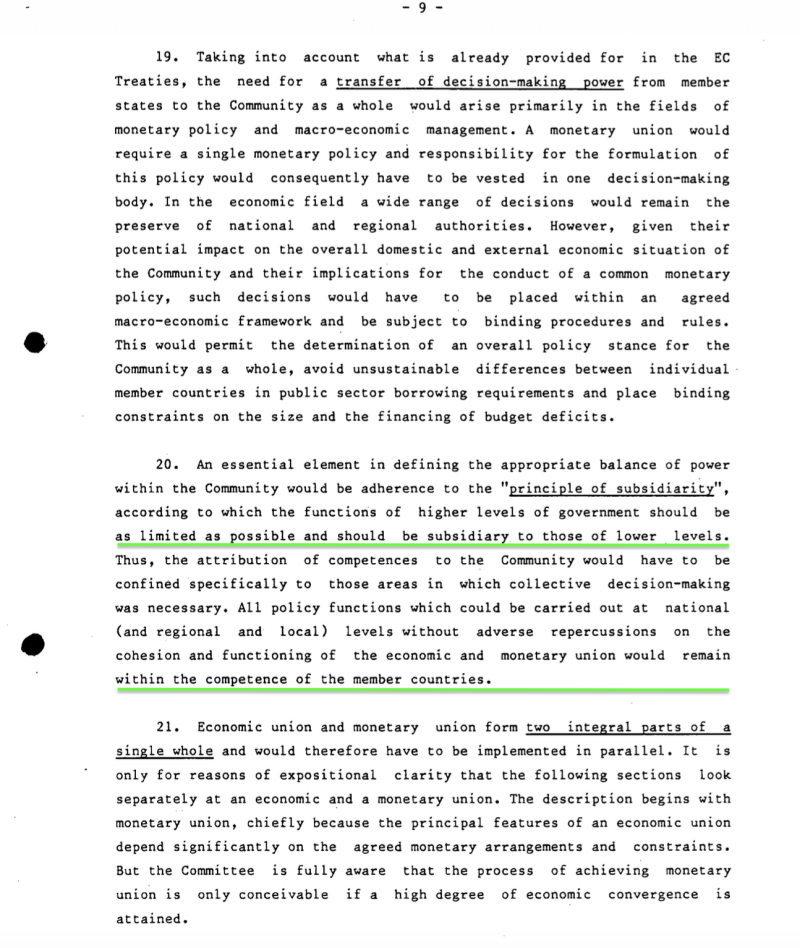
A Constitution of Liberty that serves as an economic 'can-opener' would be a logical outcome for protecting the individual when applied in the context of Militant Democracy. In fact it might be a necessity, provided that human dignity remains respected by emphasising issues such as press freedom, whistleblower protections and freedom of association. These are topics that several dictatorships in the past inspired by Hayek have neglected. Such legal setup is also consistent with the 1989 "Report on Economic and Monetary Union in the European Community" where paragraph 20 cites the principle of Subsidiarity for higher levels of governance.
Enforcing such a constitution would in many ways open the 'Pandora Box' of everything that existing constitutions, which may have been inspired by a similar logic have not achieved or done wrong, everything illiberal. It would make, in reference to Cardinal John Henry Newman, the difference between an economy, society and individual freedom based on notional versus real assent.
Article 79(3) has a clear (formal) link to this constitutional concept and also to digital currencies and their application. Yet there is very little case-law at the moment to prove to what extent it can prevent digital currencies from infringing upon individual liberties. So the hypothesis that Article 79 (3) means everything for keeping the state and spontaneous order in check in the EU is a bit preliminary, logical on paper. Yet case-law and practice will have to prove the reality of that idea.
Add comment
Comments