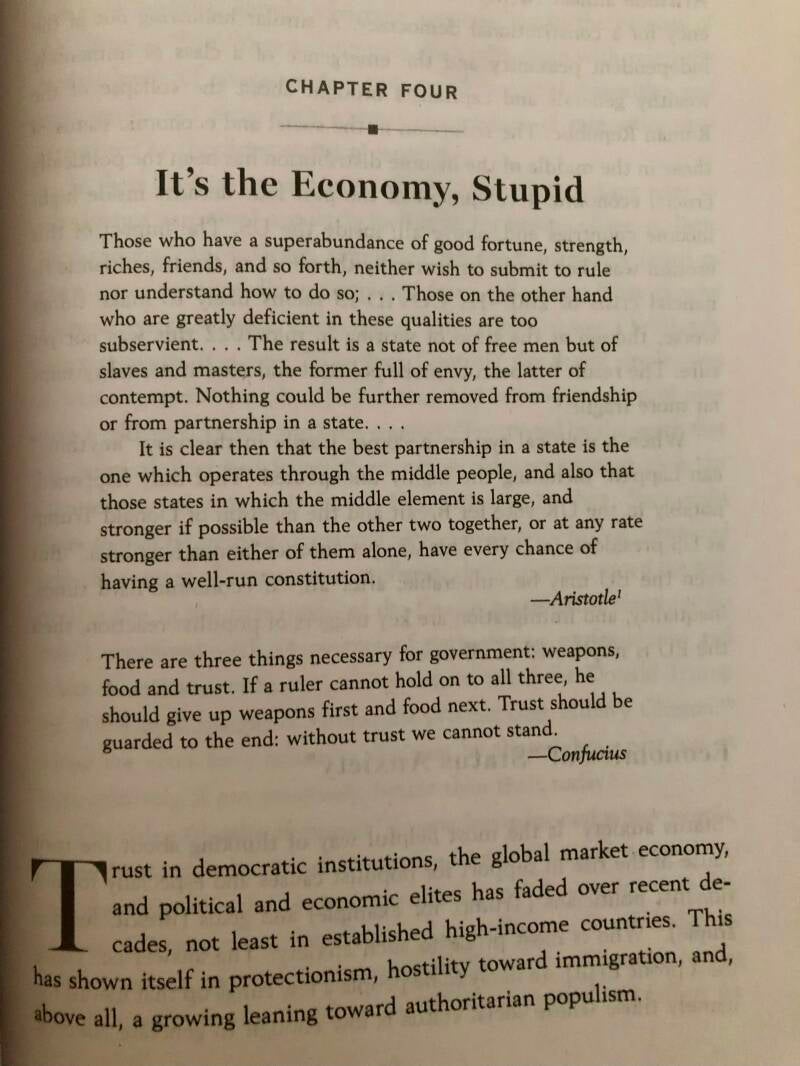
'The Crisis of Democratic Capitalism' is a book written by Professor Martin Wolf in 2023 and highlights a serious problem: He argues that Democracy and Capitalism need each other for both to function well and hence for society to be free, yet the marriage between these two is under pressure. This article provides an analysis of his book, as well as a short comparative study between two legal building blocks. There are two constitutions that are in particular relevant for Capitalism, Liberal Democracy, the EU and the Euro. These are as follows and are explained below : i) the German Constitution of 1949 and ii) the Chilean Constitution of 1980. The first one was adopted after World War II in response to Nazi tyranny, and is a leading legal framework for liberalism under democracy, and hence also for EU law. The second one was adopted under authoritarian rule, following disharmony between different social classes in Chile, and is as such subject of controversy for understandable reasons. Its importance is in the fact that it provides a leading legal framework for global liberal capitalism. Part i) gives an analysis of 'The Crisis of Democratic Capitalism', Part ii) analyses the German constitution of 1949 and Part iii) analyses the Chilean Constitution of 1980. Part iv) links core findings together and Part v) concludes.
i) The Crisis of Democratic Capitalism
This book of about 390 pages (474 including bibliography) provides a semi-academic overview of the benefits of, as well as the challenges to Democratic Capitalism. Its reference point is the 21st Century, with democratic capitalism overall having started during the Cold War, as well as several earlier historical roots. One of the first distinctions made in the earlier chapters of the book is liberalism versus illiberalism. This highlights an important assumption: It is liberalism that keeps the marriage between democracy and capitalism together, and implies the presence of Rule of Law, a requirement for rational decision-making. The warning issued on page 39 of the book is crystal-clear: "The great story of democratic capitalism - the fragile marriage between competitive market capitalism and liberal democracy - may end quite soon. Do not assume otherwise. That would be foolishly complacent."
This poses the question, why then have calibrated capitalism, is it not bound to fail? There is no easy answer, but it pays to resort to a construct based on objective criteria in law that seeks to uphold this marriage, assuming that nature ultimately decides the outcome. Many of these criteria can be found in German law and apply at the EU level too. If these fail, the EU could technically fail as a democratic Union. If that is true, before calibrated capitalism is assessed on the merit, the value of the EU's efforts thus far would have to be completely re-evaluated, which is out the scope of this article.
Part I of the book emphasises that capitalism and democracy need each other, and that democratic capitalism is likely the only kind of functioning democracy we will see. In that context, capitalism determines peoples ability to make choices and employ their talents and aspirations in the economy to maximise freedom and wealth, whereas democracy determines peoples ability to decide on matters of collective public interest. There are two extreme scenarios in which this combination no longer holds: i) Socialism, where the State takes control of all private property and hence all of the economy becomes public ii) Capitalist Plutocracy, where private actors in the economy take control of the State and politics and hence of public affairs. A picture is being painted too of, for example, State Capitalism in China, which is more strategically managed but leaves less room for political and human rights.
It is stressed that capitalism and (Western) liberal democracy will have to be saved together.
Part II of the book gives an overview of historical economic performance in Western-European Countries as well as the US and how their democracies are increasingly under pressure. Some of the indicators used include a Gini-Coefficient comparison by country, including a pre-and postax comparison. The Gini-coefficient is an indicator for measuring inequality by dividing the area under a linear line between wealth and population percentage with that of the actual Lorentz curve. This coefficient can take on a value between 0 (perfect equality) and 1 (perfect inequality), and can be applied to both income and wealth. By this measure, in the used sample , the Gini coefficient for income without tax adjustments is the lowest for Belgium at 0.26 and the highest for the US at 0.39. Another finding is that mean to median real income has decreased significantly, particularly in the US.
A major disturbing event in Western democracies and the world as such was the Global Financial Crisis of 2008. A core determinant in this crisis was the increased indebtedness of countries and households alike. A mentioned difficulty is inability to distinguish what part of economic growth is attributed to genuine higher levels of productivity, versus some form of rent-extraction, particularly for the financial sector (p. 99). A stagnant economy, it is said, leads to a zero-sum situation in which the gains for A go at the expense of B and vice versa. Another mentioned flaw is that policy mistakes regarding economics are largely invisible to the public. A reminder to this problem, from my own observations, is the usage of off-sheet accounting in relation to public finances.
New challenges that emerge have been summarised as follows on page 172: Climate change, Artificial Intelligence, and the Pandemic (referring to COVID). Technological transformations are said to impact the market-oriented rewards of workers and contribute to excessive capital gains, reinforcing a rentier-economics. In addition, the pandemic has added fiscal deficits to the economy.
These changes are described as a catalyst for populism, and one concern carries particular risk for Rule of Law: The undue usage of emergency powers, with reference made to two of the most extreme case in the twentieth century: The Reichstag fire of 1933 giving rise to Hitler, and the Moscow bombings of 1999 giving rise to Putin (p. 181). The most dangerous form of populism for liberal democracy is of the anti-pluralist variant, opposed to racial equality, rule of law, free press, academic freedom etc. Interestingly, a synthesis has been sketched between populism and trickle-down economic that mainly benefit the absolute top of society's wealth distribution: Pluto-populism, essentially establishing plutocracy by dispersing populist rhetoric that appeals to often disadvantaged classes. A strong enabling factor is the financial contribution in politics by ultrawealthy donors: the 0.01 percent wealthiest part of the population makes 40 percent of financial contributions to US politics, and a Supreme Court Ruling of 2010 denoted firms as persons and money as free speech (Citizens United case) (p. 205).
What the pandemic revealed as another catalyst for populism according to the author, is hyper-individualism, the war of all against all, as visible in the consistent emphasis on doing as one pleases regarding mask mandates and other public protection measures. This became more profound with the weaponisation of outrage through social media. Finally it is noted, that trust in democracy has been eroded further, and that an increasing percentage of voters instead longs for a competent authoritarian.
Part III of the book searches for solutions to the identified problems, and begins with the notion that universal suffrage democracy needs to be open to market incentives, and the marketplace needs to be receptive of the people.
One of the main mistakes of the twentieth century, it is noted, is the desire to engineer a kind of superman devoid of the constraints of ordinary human beings with their flaws. This was a core theme of Marxist/Leninist communism as a successor to the more inegalitarian Tsarism of Russia in centuries before. This attempt has not been successful and caused immense economic and human destruction instead. As a result, the conclusion is drawn that a top-down, state-planned economy does not work, the market is instead a better mechanism for dispersing information effectively across society and no single validated model of the world exists, this would constitute naive rationalism/scientism (p. 234). Uncertainty is thus normal.
With this in mind, the book proposes that policy-makers reduce barriers to equality of opportunity (not outcome), to an extent that is reasonably possible. In pursuit of reducing these barriers, reference is made to the five giants of "want, disease, ignorance, squalor and idleness.", in which governments have a role to play. Yet the notion of Universal Basic Income is dismissed as unaffordable in practice. Even if it is affordable, it remains ill-targeted (p. 283), citing instead suggestions such as government borrowing at current negative interest rates for investments in social security provisions.
One of the most important undeniable challenges remains the eradication of corruption. A core requirement for this is the separation between wealth and power, and it is also defined as the most difficult one.
Emphasis is added on using a taxation system that has carries modest economic costs and is targeted at identifiable externalities, such as carbon emissions, as well as some form of tax on capital. Core to democracy is the concept of citizenship, and upholding a degree of patriotism to counter nationalism, with the former cited as a defensive attitude, whilst the latter involves a desire for power (p. 322).
Part IV outlines an important clash of ideas, namely that of individual freedom as we have it in Western democracies versus a more authoritarian vision that characterises China. An important assumption is that the World Trade Organisation, an important body for supporting global trade, is largely modelled after Western-style business economics in which businesses operate freely, subjected to law, assessed by independent courts. The Chinese model on the other hand, has a more complex interplay between State and market in which certain parts of the economy are based on private enterprise while at the same time having large state-owned banks and state guidance (p. 366), and actively strives to become a global economic powerhouse. Now that it has launched the Belt and Road initiative for economic development and international cooperation, liberal democracies are encouraged to provide their counterpart.
The challenges identified by Professor Wolf, as well as several proposed solutions, leads us to the German Constitution of 1949 and Chilean Constitution of 1980. Both constitutions have been established with the aim of upholding a synthesis between market and democracy, yet their backgrounds and impact vary significantly.
ii) The German Constitution of 1949
Background: The German Constitution of 1949/Basic Law of the Federal Republic of Germany was voted on after having experienced the horrors of Nazism, Fascism, as well as the rise of Communism. It was adopted on 23 May 1949 by the Parliamentary Council, after having been ratified by more than two-thirds of the parliaments of the Länder (https://www.gesetze-im-internet.de/englisch_gg/englisch_gg.html). The Federal Constitutional Court has the last word on the interpretation of the Constitution, and is thus considered the "Guardian of the Basic Law" (https://www.bundesverfassungsgericht.de/EN/BasicLawLegalBasis/TheBasicLaw/thebasiclaw_node.html). It was designed in such a way that it is almost impossible to alter the shape of government, in this case democratic government based on solid legal principles that emphasise rule of law and curb illiberalism. One such way to curb it is the requirement of at least two-thirds in both houses to make amendments to the Basic Law (Article 79).
The Federal Republic of Germany has been divided into 16 Länder/Federal States. (https://www.deutschland.de/en/topic/politics/germany-europe/federal-states)
The most important principle of the Basic Law has been set out in Article 1, which says that human dignity shall be inviolable and forms the basis of all government power. This is a core tenet of liberalism. It must be said that this constitution was adopted before the Berlin Wall was erected, so although Nazism and Fascism had already shown their horrors on full display, the impact of Communism had remained somewhat more distant and indirect until that point. In any case, the German Basic Law makes clear distinction between what constitutes good versus what constitutes evil from a perspective of natural law, liberal versus illiberal, having endured the horrors of politicide, genocide and concentration camps.
Overall legal setup
The German Constitution has been divided into 11 Chapters as well as extracts from the Weimar Constitution of 1919.
Chapter I contains the Basic Rights. Article 1 till 19 specifies the Basic Rights under German Law, with Articles 2-19 being provisionary towards Article 1.
Chapter II contains the Constitutional Setup Article 20 describes the German government as a Democratic Social State in which all authority rests with the people, a principle that applies across the country, including all the federal states. The German Eternity Clause, which can be found in Article 79 (3) deems it impossible to make amendments to the Basic Laws laid out in Article 1 and 20.
Article 23 takes the logic of German Law abroad towards European Union, which did not yet exist in its current form, but in many ways paved the way for the European Steel and Coal Community which was established in 1952 (https://europa.eu/ecsc/index_en.htm).
The Article defines the principle of subsidiarity at home and its application to Europe as follows:
"[European Union – Protection of basic rights –
Principle of subsidiarity]
(1) With a view to establishing a united Europe, the Federal Republic of Germany shall participate in the development of the European Union that is committed to democratic, social and federal principles, to the rule of law and to the principle of subsidiarity and that guarantees a level of protection of basic rights essentially comparable to that afforded by this Basic Law. To this end the Federation may transfer sovereign powers by a law with the consent of the Bundesrat. The establishment of the European Union, as well as changes in its treaty foundations and comparable regulations that amend or supplement this Basic Law or make such amendments or supplements possible, shall be subject to paragraphs (2) and (3) of Article 79. There again, reference is made to the Eternity clause, which means that EU law, including decisions of the European Central Bank, can face legal scrutiny from the German Constitutional Court if actions or laws are deemed incompatible with the Eternity Clause."
Specifications regarding finance and property
Chapter 10 of the Basic Law deals with financial matters. Regarding financial liability, it is explicitly stated in Article 104 that expenditures by the Länder are separate from Federal expenditures, unless provided otherwise in the Basic Law. Article 104 says that also includes list of financial tasks, ranging from investments in social housing (Article 104), Budgetary Emergencies (Article 109), to Limits on Borrowing (Article 115).
Article 115 defines these limits as follows:
"Revenues and expenditures shall in principle be balanced without revenue from credits. This principle shall be satisfied when revenue obtained by the borrowing of funds does not exceed 0.35 per cent in relation to the nominal gross domestic product. In addition, when economic developments deviate from normal conditions, effects on the budget in periods of upswing and downswing must be taken into account symmetrically."
This could be explained by the desire to avoid the financial catastrophe that collapsed the Weimar Republic. Article 109 has authorised the creation of the German Stability Council, which was established in 2010. Its Rules of Procedure can be found on the right.
Competences of the German Federal Bank/Bundesbank are outlined in Article 88 (Chapter 8) as a bank established for the purpose of issuing notes and currency. Though no other specifications are given, it is emphasised that its powers may be transferred to the European Central Bank under EU law for the goal of price stability. This makes the link with the European Union and its internal market clear, and helps explain the ECB's requirement to respect the Eternity Clause. A study on the German interbank market during the Global Financial Crisis has been attached on the right.
(https://www.bundesbank.de/resource/blob/764488/3808ffbe3f45770d56d08542bebc0f87/472B63F073F071307366337C94F8C870/2016-08-research-brief-data.pdf).
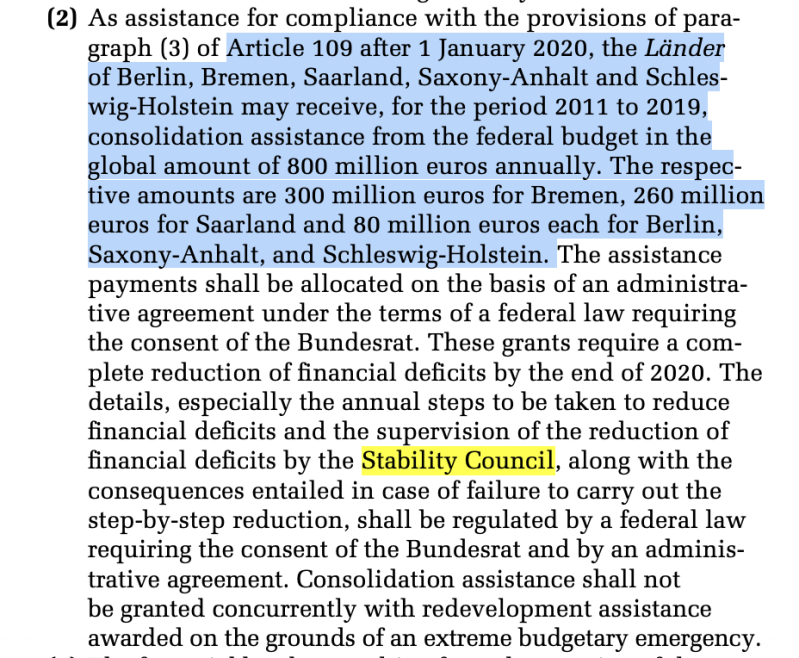
Article 109 describes the German Stability Council. This is a joint body, set up to avoid budgetary emergency, has power to supervise the budgets of both the Federation and the Federal States (Article 109a). The most recent version of the Basic Law includes a specified budget in Article 143 regarding consultation assistance for the years 2010-2019 in order to comply with the German Stability Council. The amounts specified in Article 143(2) can be seen in the excerpt on the right.
Property rights are covered under Basic Rights, Article 14, which says that "Property and the right of inheritance shall be guaranteed. At the time, Article 14(2) says that "Property entails obligations. Its use shall also serve the public good.", which means it is more than a strictly individual matter. Expropriation may only occur in the interest of the public good pursuant to law (Article 14(3)).
Armed Forces
The Basic Law has outlined the competences, rights and duties of the Armed forces in Article 87a. Article 87b describes the relevant judicial oversight mechanisms. Article 87 (1) and (1a) say the following:
(1) The Federation shall establish Armed Forces for purposes of defence. Their numerical strength and general organisational structure must be shown in the budget.
(1a) For the purpose of strengthening its ability to honour its alliance obligations and its defence capability, the Federation may establish a special fund with its own credit authorisation for a single amount of up to 100 billion euros. Paragraph (3) of Article 109 and paragraph (2) of Article 115 shall not apply to the credit authorisation. Details shall be regulated by a federal law.
Clearly the employment of Armed Forces in Germany is defensive in nature, subservient to democratic law.
Direction
A recent amendment was adopted in 2024 with more than 600 votes in the Bundesrat and the day after endorsed by the Bundestag, surpassing the required threshold of two-thirds. This change enshrines the FCC's status into Basic Law to protect it from political interference. (https://blog.bham.ac.uk/lawresearch/2025/01/strengthening-the-resilience-of-the-german-federal-constitutional-court/).
The decision strengthens Germany's commitment to uphold liberal democracy and protect it against illiberal forces. And given the position of the FCC in relation to Europe, it can demand and remind the EU to do the same.
From its onset, the German Basic law can be considered as moving away from a Prussian tradition in terms of government setup, radically defending its democracy against attempts to bend it. At the same time, the legal vigour it employs has a Prussian element in its own right.
iii) The Chilean Constitution of 1980
Background: The Chilean Constitution of 1980, mainly formed by legal scholar Jaime Guzmán Errazuriz, was adopted following a plebiscite in 1980, after approximately 7 years of authoritarian rule under martial law by general Augusto Pinochet (https://doi.org/10.61490/eial.v33i2.1768). Chile is a unitary State, divided into 16 regions.
Pinochet's rule started with the bombing of La Moneda Palace on 11 September 1973 (the other 9/11), which violently overthrew the government of President Allende and marked the end of Chile's existing democratic legal order. Especially the first 4 years were characterised by severe political repression, leaving at least 3,000 people dead (though more recent estimates hint at a higher number of individuals), subjecting several thousands political prisoners to torture, often in remote places and even concentration camps, and resulting in thousands more people fleeing into exile. Especially feared in this context was the DINA, a secret service directly answerable to the general, resorting to repressive methods that were almost unmatched by other secret agencies in the world (https://www.bbc.com/news/world-latin-america-24319770). Needless to say some of these acts are evil by any standard of natural law. The main official justification for this political repression was the fight against totalitarian infiltration and the political crisis at the time, with the risk of systemic damage to the countries economy and political institutions. (https://cidh.oas.org/countryrep/chile74eng/chap.4.htm). Though there is tangible evidence for these concerns, the level of repression remains a topic of debate and has resulted in several indictments for crimes against humanity. Key objectives of the military were economic and institutional stabilisation, curbing hyperinflation and setting up an economic framework that would open up the country to foreign trade and investment to the max, which they have largely been achieved at the time of return to democracy in 1990, but not without loss of life (as discussed) and heavy economic side-effects, resulting in a major crash in 1983. An analysis of this situation can be found at Bank of Chile (document attached on the left).(https://www.bcentral.cl/documents/33528/133326/DTBC_57.pdf/8cc3195c-f838-f2d0-6a75-5052adbb3e2c?t=1693236872076).
The liberalisation programme began with the consultation of an economic group called the Chicago Boys in 1975 and implementation of advised economic policy. The first reforms drew heavily on teachings from the University of Chicago, with (https://www.promarket.org/2021/09/12/chicago-boys-chile-friedman-neoliberalism/). Many of their ideas centred on the concept of a completely unrestrained free market, including rapid privatisation of public assets and massive budget cuts. These were achieved through the usage of emergency powers (see previous references) of the junta. The concept of homo economicus, the rational individual participating in the economy, was largely coined over there at that time. Without adjustments, it is somewhat an oversimplification of the individual, as people are not always rational. Yet the concept fits well with the Prussian tradition that characterises the Chilean army and a culture of rationality and strict discipline. Whether this oversimplification has contributed to the Global Financial Crisis as a result of overoptimistic models is hard to tell for now, but something worth further research. Chile has already resorted to moderations as early as 1983 following the severe crash as described above.
Despite the adoption of the new constitution through popular vote in 1980 as a move towards liberal democracy, the document gives the President of the Republic a high degree of executive power, which is difficult to alter.
Overall legal setup
The Chilean Constitution defines Chile as a Democratic Republic in Article 4. The document has been divided into 15 Chapters. Chapter 1-14 include the existing articles effective since 1980, whereas Chapter 15 includes amendments to the constitution of 1980. Finally, there are transitory provisions as well. It has entrenched a strong emphasis on free-market logic, which is almost impossible to alter, where the Chilean State as a subsidiary State. This conclusion can be derived from Article 19, which defines the Constitutional Rights and Duties of each individual. Title 18 defines social security provisions and Title 21 defines the right to develop any economic activity which is not contrary to morals, to the public order or to national security. Though there are provisions regarding welfare, these are adopted to the extent that the market cannot provide them.
Chapter IV deals with the powers of Government, and hence with those of the President of the Republic, who enjoys significant executive power. For example, Article 32 outlines the special attributions of the President, which include the right "To appoint and remove at his will the Ministers of State, undersecretaries, intendants and governors." in Title (7).
Conditions for amendments to Chilean law are covered in Article 127 and require a quorum of three-fifths in both Chambers by default. If it concerns an amendment that deals with issues in Chapters 1, 3, 8, 11, 12 or 15, a two-third majority is required.
Specifications regarding finance and property
Chapter 10 deals with state budgets, which are overseen by the Office of the Comptroller of the Republic. Article 100 says that "The Treasuries of the State cannot effect any payment except by virtue of a decree or resolution of a competent authority, in which the law or the part of the budget which authorises such an expenditure, is stated."
Article 109, regarding the functions of the central bank, says the following regarding guarantees and transactions: "The Central Bank may only effect transactions with financial institutions, either public or private. In no way whatsoever can it grant to them its guarantee, or secure documents issued by the State, its organisms or enterprises.
No public expenditure or loan may be financed with direct or indirect credits of the central bank."
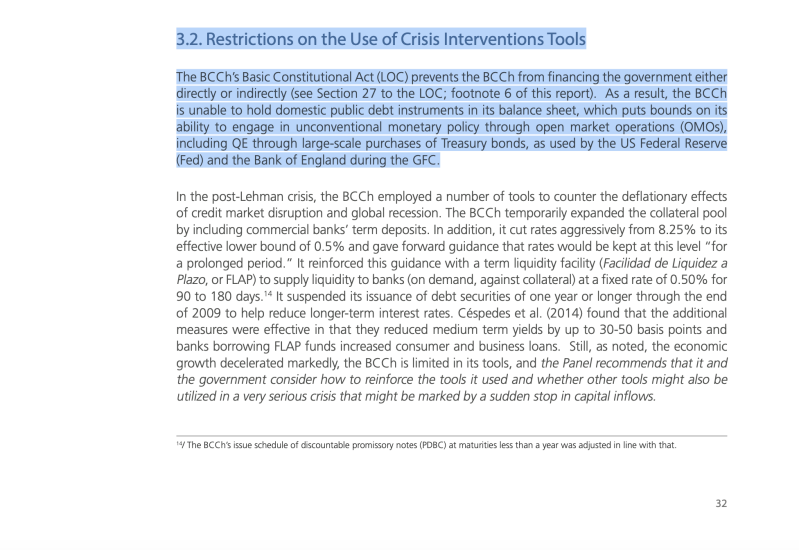
Notably, this measure also applied during the Global Financial Crisis of 2009 and its aftermath, which meant that the Bank of Chile did not engage in Quantitative Easing or direct purchases of government debt (unlike the ECB, Bank of England and US Federal Reserve), although there have been targeted monetary operations
This can be seen in the excerpt from Bank of Chile on the left (https://www.bcentral.cl/documents/33528/2077651/Independent_Evaluation_Panel-Full_Report.pdf).
Property Rights are covered under Article 19, Title 23 and 24. Title 23 gives individuals "Freedom to acquire ownership over all classes of assets, except those which nature has made common to all men or which should belong to the entire Nation, and that the law so declares." Here again, there is a social element to property rights, albeit not so explicit in terms of obligations towards the common good.
The Chilean Constitution of 1980 has formed a fairly prominent building block for global capitalism, particularly so in the context of the Cold War. Given the time at which the constitution was adopted, a neoliberal foundation had been laid already before many Western democracies began implementing neoliberal policies, such as the US, UK and increasingly, EU countries. Likely so, it has left an economic imprint on China as evident from Deng Xiaoping's adoption of market-policies that synchronised economic relations with Chile despite their ideological difference (https://dialogue.earth/en/business/390865-copper-pragmatism-and-going-green-a-history-of-chile-china-relations/).
Armed Forces
Articles 101-105 specifies the competences, rights and duties of the Armed Forces, though Article 106 and 107 are related too. Article 104 says that "The Commanders-in-chief of the Army, of the Navy and of the Air Force, and the General Director of the Carabineros will be appointed by the President of the Republic from among the five officers with the most seniority who have the qualifications which the respective institutional statutes require for such positions. They will serve for four years in their functions, cannot be appointed for a new period and will enjoy irremovability in their positions."
Some scholars say that the Armed Forces have not retained the neutrality and apolitical attitude which the Constitution of 1925 prescribed, such as Sigmund (https://www.scielo.cl/scielo.php?script=sci_arttext&pid=S0718-090X2003000200012). He argues that this was visible in the appointment of key military personnel by the former dictator, and the level of immunity that he and other (former) members of the Armed Forces have enjoyed since then.
Direction
Given the context of implementation under authoritarian rule and subsequent return to democracy, attempts have been made to reform the Chilean Constitution, as evident from the attached document including changes up to 2021. These include attempts to achieve gender balance in the election of Constituents and inclusion of indigenous groups. Following large-scale protests in 2019, attempts have also been made to draft a new constitution, yet this has failed.
Instead, with the election of José Antonio Kast, targeted changes are made which tilt the document into a more rightward shift under what is described as an 'emergency government' (https://www.gob.cl/en/news/president-jose-antonio-kast-announces-two-bills-to-combat-illegal-immigration/).
iv) Comparison and synchronising two constitutions to safeguard the marriage between democracy and capitalism
Both the German and Chilean Constitution have clear specifications regarding the role of the State, the principle of Subsidiarity, the national Treasury and the Armed Forces to protect the institutional setup of the respective countries. A core difference between the German Basic Law and the Chilean Constitution is that the former has a more extensive list of specified economic rights, duties and tasks for the State. The latter clearly describes Chile as a subsidiary State. Both have a Social Market Economy, with some differences. The German Constitution seems to follow a closer adherence to natural law/liberalism and emphasis on human dignity, where nobody is above the law, having learned from the experience of totalitarianism from various angels. The Chilean one has more radical emphasis on economic flexibility and market rationality, and is strongly opposed to Marxism, which is essentially a form of totalitarianism. Yet the question of whether nobody is above the law in Chile, is more difficult to answer, given the vast executive powers that the president of the republic enjoys, as well as the power of the Armed Forces which dates back to its authoritarian reaction towards marxism, making amendments very difficult without approval of 'the old guard', a persistent source of tension, and would moreover be problematic from the perspective of the German Eternity Clause. This would certainly have been the case for the political repression that occurred under authoritarian rule.
Given the adoption of different economic models and the clash of ideas as described by Professor Wolf, it can be concluded that the different economic models developed in the EU, and in the Cold War, with Chile as a main laboratory, are in conflict versus each other to a degree. It would have been interesting to read his views on the usage of emergency powers in Chile, and to what extent it was legitimate or not. The fact that this constitution was implemented after a coup d'etat and the rise of a regime that prioritised maximum market rationality and economic logic over democracy may in fact be the best argument to use its logic in countering state capture from the perspective of democratic capitalism, especially in light of Wolf's findings that increasing percentage of voters display longing for a competent authoritarian over a democratic leader. It is therefore sensible to synchronise the logic of the Chilean constitution with the German constitution so as to better understand our economies in Continental Europe as well as potential risk factors to it, especially since Global Financial Crisis of 2009. Although the Eternity Clause and hence Basic Rights under German law is the ultimate legal constraint on Calibrated Capitalism, it pays to incorporate ideas of the Chilean Constitution insofar as compatible with the German one. This would be a dynamic process that does not fit within one article, there are no ad hoc results, rather, to use a quote from Von Hayek,
"What the liberal must ask, first of all, is not how fast or how far we should move, but where we should move." (Postscript to the Constitution of Liberty: Why I am not a Conservative, 1960). Hayek posed the question of whether a dictator can use a nation's constitution as a can-opener, and reference was made to Chile in fact (Andrew Farrant & Edward Mcfail, 2013, https://doi.org/10.1080/09538259.2014.932063). We argue that this logic should be applied in a more humane manner in contemporary liberal democracy and correct the previous application of this idea: By helping whistleblowers and individuals who report infringements in law and markets, we can make vast improvements to our market economy and democracy alike by finding flaws in the existing economic and democratic setup, in the EU, but also elsewhere. It seems Prussian traditions have inspired the neoliberal model and put it somewhat at odds with contemporary liberal democracy if no adjustments are made. Hence, we think a Prussian element is needed precisely in defence of individual rights and capitalism under liberal democracy to counter, among others, illiberal autocrats.
v) Conclusion
Based on above findings, the following conclusions are drawn:
i) The German Basic Law of 1949 is a key document in protecting liberal democracy both at home and at European level, with a market economy that involves some degree of regulation and state intervention under a social market economy, in which the Eternity Clause acts as an ultimate legal limit on what is acceptable under this liberal democracy, giving the Federal Constitutional Court of Germany a prominent position for constitutional review of both acts and laws in Germany as well as the EU.
ii) The Chilean Constitution of 1980 provided a legal safeguard for a fairly radical variant of neoliberalism/social market economy. In the buildup to this constitutional order and afterwards, Chile has served as a laboratory for different variants of market-economics that have been adopted on a global scale, ranging from authoritarian state-led capitalism in China, to more laissez-faire capitalism in the US and UK, and Social Market Economics in a way that is compatible with German law in the EU, and these different models have followed a similar direction under the unipolar/neoliberal global model for decades.
iii) Whereas the German Basic Law's direction seems to be a solidification of its existing liberal democracy against illiberalism, the Chilean Constitution seems to take more of a rightward shift compared to its original neoliberal direction, reducing the economic intervention by the State whilst tightening national security measures.
Since neither of the two documents analysed constitutions have been mentioned in Martin Wolf's book despite their relevance for democratic capitalism, including them in future research and keeping track of similarities and divergence becomes all the more relevant for protecting freedom and learn from the excesses of the 20th Century, so that the economy and the law can be shielded against future forms of leftist and rightist totalitarianism.
Disclaimer: Despite Calibrated Capitalism's strong reliance on core provisions in German law as safeguarded by the Eternity Clause, this analysis was not intended to promote German law in its favour as an infallible source, and does not deny potential deficiencies in German law. Likewise, deriving input from the Chilean Constitution in terms of logic and economic thinking, this analysis does not downplay potential deficiencies in Chilean law nor the severe abuses that occurred under the Pinochet dictatorship before and at the time of implementing the constitution. Instead, it seeks to balance the logic of both laws to have an optimal economic construct in technical and legal terms, that respects market capitalism under liberal democracy as a 'bloc' and guards it against adversaries, because both documents have content that is important, with the German Constitution having primacy/priority over the Chilean one.
Add comment
Comments