Since the Ukraine invasion of February 2022, it is estimated that about $300 billion worth of Russian financial assets have been confiscated worldwide, according to the Polish institute of national affairs (https://pism.pl/publications/prospects-for-the-use-of-frozen-assets-of-the-central-bank-of-russia) as referred to in this report by the European Parliament of September 2025 (https://www.europarl.europa.eu/RegData/etudes/BRIE/2025/775908/EPRS_BRI(2025)775908_EN.pdf), though there is an estimate of as much as €300 billion. Around €180 billion of those are being held at Euroclear in compliance with the EU sanctions on Russia.
Yet as of several days ago, Russian courts have contested this decision in a bid to recover these assets. One of the companies who filed a lawsuit at Russia's Ninth Arbitration Court (Moscow) is Pervaya Management Company, formerly registered as Sber Asset Management (according to this article from Russian News Agency https://tass.com/economy/2134135). The amount requested to be paid stood initially at 2.5 billion USD according to the source, and has a been reduced to 448 million USD.
About Pervaya
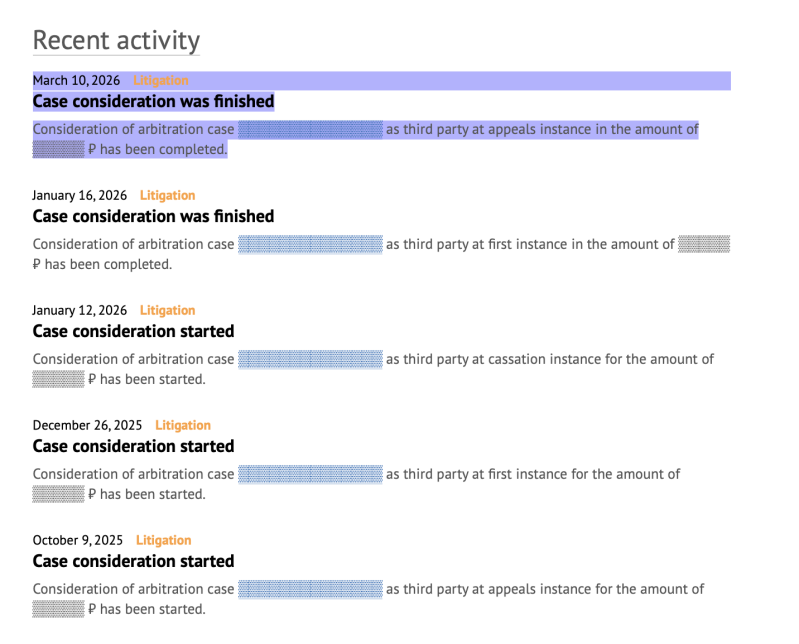
Pervaya Management Company has been listed as UK Pervaya AO (SBCN) on the Moscow Exchange. The firm was incorporated in 2002 as Sberbank Upravleniye Aktivami according to this page at MSN.com (https://www.msn.com/en-ie/money/stockdetails/fi-c8l3z2?id=c8l3z2). Since 2012, its CEO has been Belyaev Artem Nikolaevich, as found on myseldon.com, there the firm is referred to as LLC "Pervaya management company" established in 2012, indicating a rebrand. It is mentioned that the company is currently not involved in any legal proceedings as a plaintiff, which it would be if it were claiming damages against Euroclear. This implies that the arbitration case has been closed, which is consistent with the second sheet on myseldon.com (see first two pictures below).
It is noteworthy that Pervaya has been excluded from EGRUL on 17 August 2015 (according to the myseldon database). EGRUL is Russia's official Unified State Register of Legal Entities (you can find the official link over here https://egrul.nalog.ru/index.html). This means the company can circumvent certain legal reporting requirements. At the same time it is mentioned that there are two co-owners according to EGRUL. Whether that still is, cannot be proven then.
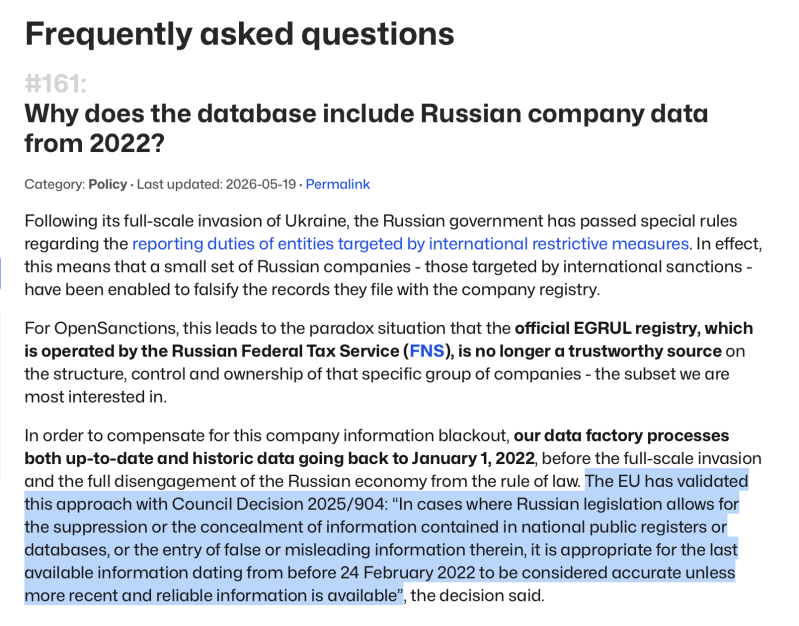
According to OpenSanctions, the Russian government has designed specific rules for several targeted entities regarding reporting to EGRUL, since the invasion in Ukraine (see third picture below, excerpt from https://www.opensanctions.org/faq/161/egrul-2022/).

Background of the cases involving Pervaya and Euroclear
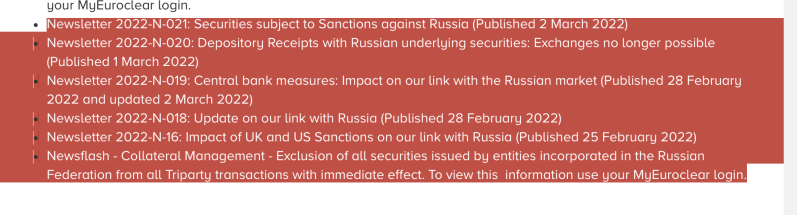
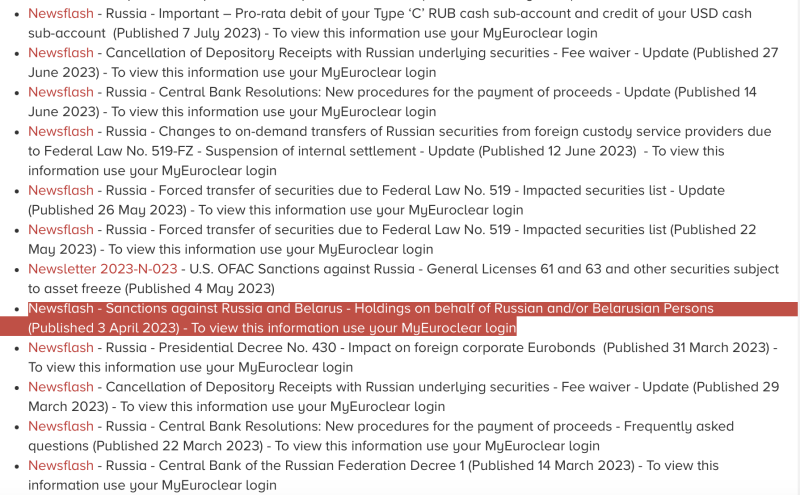
Since the Ukraine invasion of 2022, Euroclear has frozen Russian assets in compliance with EU and other international sanctions. Within days, Euroclear froze Russian Central Bank Assets of approximately €185 billion, and has since then held a timeline named "Current status on our link with Russia". The initial actions in compliance with EU, US and UK sanctions can be found at the bottom (see below).
We cannot obtain the official documents of the case (for now at least), hence the start of the case must be reconstructed by external sources. According to a press release on 12 July 2023 by Turkish news outlet Anadolu Ajansi (https://www.aa.com.tr/en/economy/russian-company-files-lawsuit-worth-nearly-2b-against-euroclear-bank/2944194), the company issued a lawsuit on Wednessday at the time of writing, meaning either 12 July or 5 July. This is fairly consistent with Euroclear's timeline and may have been a response to the statement of 3 April 2023 regarding 'Sanctions against Russia and Belarus - Holdings on behalf of Russian and Belarusian persons'. The initial amount claimed was 184.8 billion Russian rubles or 2 billion USD. Later on, the amount claimed was reduced by approximately 40% according to
On 12 December 2025, the Bank of Russia issued a statement (https://www.cbr.ru/eng/press/PR/?file=639011472901412429OBAUT_E.htm) that it initiated a lawsuit against Euroclear through the Moscow City Arbitration Court. It is stated that the case relates to 'unlawful activities of the Euroclear depository'. This means that i) The Bank of Russia a priori has determined that actions of Euroclear in response to regulatory demands is unlawful ii) the actions of Euroclear have caused damage to the Bank of Russia, implying that causality can be attributed to Euroclear.
An Interfax article of 17 December 2025 (https://interfax.com/newsroom/top-stories/115341/) has summarised that the Bank of Russia described that the damage "is comprised of the sum of blocked funds and the value of blocked securities belonging to the regulator, as well as lost gains". This has had impact on Euroclear's credit ratings at Fitch as follows: Long-term Issuer Default Ratings (IDR) AA have been put on Rating Watch Negative' on 16 December 2025 citing "potentially increased liquidity and legal risks for Euroclear Bank and EH (jointly Euroclear) from the European Commission's (EC) plans to use the immobilised assets of the Central Bank of Russia (CBR) for a reparations loan to Ukraine as well as from the decision to use emergency powers under Article 122 of the Treaty on Functioning of the European Union on 12 December 2025." (https://www.fitchratings.com/research/banks/fitch-places-euroclear-bank-on-rating-watch-negative-16-12-2025); subsequently long term Issuer Default Rating has been affirmed as AA on 23 December 2025 and Rating Watch Negative has been removed with its view that "following the decision on 19 December 2025 by the European Council to provide financial support to Ukraine with a EUR90 billion loan based on EU capital markets borrowing backed by EU budget headroom, the likelihood of cash balances from the immobilised Central Bank of Russia (CBR) assets held at Euroclear Bank being used for a "reparations loan" without providing comprehensive legal and liquidity protections to Euroclear Bank has materially reduced." (https://www.fitchratings.com/research/banks/fitch-affirms-euroclear-bank-at-aa-stable-off-rating-watch-negative-23-12-2025).
Some legal basis for the Central Bank of Russia to file a lawsuit against Euroclear was mentioned in the 8th paragraph of this article already . Another basis, according to an interfax article of 15 May 2026 (https://interfax.com/newsroom/top-stories/117600/) is "the officially announced plans of the European Commission to freeze the Central Bank's funds indefinitely and plans to use the assets of the Russian regulator for transfer to third parties, the CBR said.". It is mentioned that the CBR has also filed a case at the General Court of the European Union on 27 February 2026.
The European Council's decision to provide a €90 billion loan to Ukraine for the years 2026-2027 backed by the EU budget headroom, following a meeting with President Volodymyr Zelenskyy (President of Ukraine) can be found in document EUCO 26/25 of 18 December 2025. Paragraph 8 of that document says that "In line with the European Council’s previous conclusions which underline that, subject to EU law, Russia’s assets should remain immobilised until Russia ceases its war of aggressionagainst Ukraine and compensates it for the damage caused by its war, the European Union, given the unprecedented situation, adopted on the basis of Article 122 TFEU exceptional, temporary and duly justified emergency measures immobilising such assets on a more sustained basis." A full explanation is found in the following document by the European Parliament: https://www.europarl.europa.eu/RegData/etudes/BRIE/2025/779267/EPRS_BRI(2025)779267_EN.pdf
Article 122 TFEU has been referred to as 'emergency law' based on a 'temporary nature' as referred to by the European Council in 2020 (https://www.europarl.europa.eu/RegData/etudes/BRIE/2025/769579/EPRS_BRI(2025)769579_EN.pdf). The Article says the following (Official Journal 115 , 09/05/2008 P. 0098 - 0098):
"1. Without prejudice to any other procedures provided for in the Treaties, the Council, on a proposal from the Commission, may decide, in a spirit of solidarity between Member States, upon the measures appropriate to the economic situation, in particular if severe difficulties arise in the supply of certain products, notably in the area of energy.
2. Where a Member State is in difficulties or is seriously threatened with severe difficulties caused by natural disasters or exceptional occurrences beyond its control, the Council, on a proposal from the Commission, may grant, under certain conditions, Union financial assistance to the Member State concerned. The President of the Council shall inform the European Parliament of the decision taken."
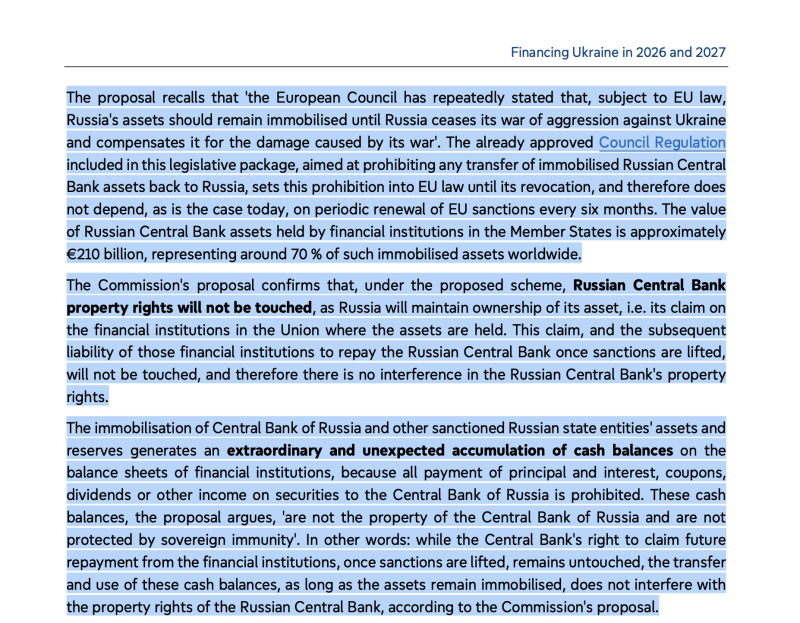
The European Parliament has provided an explanation for the Proposal as in the caption below, excerpted from the document "Financing Ukraine in 2026 and 2027- Reparations loan, revision of long-term EU budget or alternative solution?". It is clearly stated that within the proposal of the European Commission
- a Prohibition of transferring Russian assets back to Russia has been set into EU law until its revocation, so no periodic review of six months is necessary anymore, in accordance with Council Regulation (EU) 2025/2600 of 12 December 2025 on emergency measures addressing the serious economic difficulties caused by Russia’s actions in the context of the war of aggression against Ukraine, which was adopted on 12 December 2025 (and enters into force one days after its official publication). (OJ L, 2025/2600, 13.12.2025).
- the value Central Bank assets held by financial institutions in EU Member States is about 210 billion Euros, or about 70% immobilised Russian Central Bank assets worldwide.
- Russian Central Bank property rights will not be touched as Russia maintains ownership of the assets.
- all payment of principal, interest, coupons, dividends and other income on securities to the Central Bank of Russia is prohibited and do not count as property of the Central Bank of Russia, hence no protection by sovereign immunity.
A legal basis for the Central Bank of Russia to file a lawsuit against Euroclear was mentioned in the 8th paragraph of this article already . Another basis, according to an interfax article of 15 May 2026 (https://interfax.com/newsroom/top-stories/117600/) is "the officially announced plans of the European Commission to freeze the Central Bank's funds indefinitely and plans to use the assets of the Russian regulator for transfer to third parties, the CBR said.". It is mentioned that the CBR has also filed a case at the General Court of the European Union on 27 February 2026 regarding the Council Regulation on indefinite freeze of assets, referring to Council Regulation (EU) 2025/2600. This is Case T-150/26 - Action brought on 27 February 2026 – Bank of Russia v Council, held in the General Court of the European Union, located in Luxembourg City, and is still pending.
Bank of Russia would then have to contest (i) the legal validity of Article 122 TFEU in the Council decision (ii) the reason for indefinite freeze of Central Bank assets by the European Commission (in relation to the invasion of Ukraine), upon what conditions this indefinite freeze depends (iii) that the transfer of Russian assets as proposed by the European Commission to third parties (as proposed by the European Commission) constitutes an infringement of property rights, including lost potential gains on future income on securities (etc). It has indeed included lost profit as part of the damage claim, according to its own statement of 18 December 2025 (https://www.cbr.ru/eng/press/pr/?file=639016769100211523obaut_e.htm).
A legal basis for the Central Bank of Russia to file a lawsuit against Euroclear was mentioned in the 8th paragraph of this article already . Another basis, according to an interfax article of 15 May 2026 (https://interfax.com/newsroom/top-stories/117600/) is "the officially announced plans of the European Commission to freeze the Central Bank's funds indefinitely and plans to use the assets of the Russian regulator for transfer to third parties, the CBR said.". It is mentioned that the CBR has also filed a case at the General Court of the European Union on 27 February 2026 regarding the Council Regulation on indefinite freeze of assets, referring to Council Regulation (EU) 2025/2600. This is Case T-150/26 - Action brought on 27 February 2026 – Bank of Russia v Council, held in the General Court of the European Union, located in Luxembourg City, and is still pending.
Bank of Russia would then have to contest (i) the legal validity of Article 122 TFEU in the Council decision (ii) the reason for indefinite freeze of Central Bank assets by the European Commission (in relation to the invasion of Ukraine), upon what conditions this indefinite freeze depends (iii) that the transfer of Russian assets as proposed by the European Commission to third parties (as proposed by the European Commission) constitutes an infringement of property rights, including lost potential gains on future income on securities (etc). It has indeed included lost profit as part of the damage claim, according to its own statement of 18 December 2025 (https://www.cbr.ru/eng/press/pr/?file=639016769100211523obaut_e.htm)
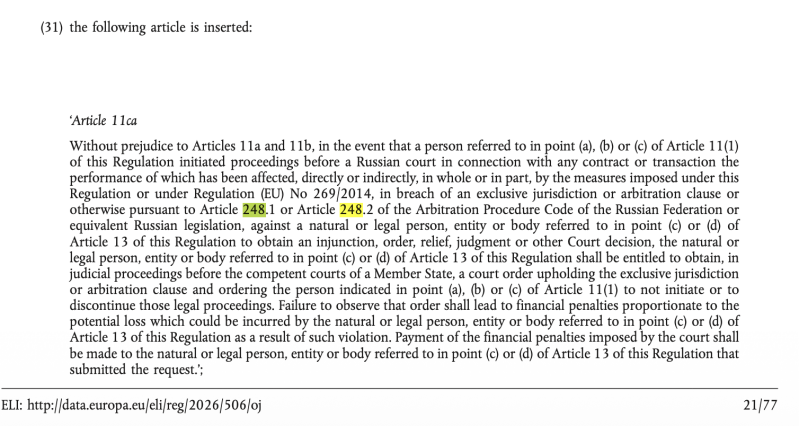
There are two legal difficulties in this regard: i) Russia has itself already allowed Russian parties to overrule international sanctions in accordance with Article 248.1 and 248.2 of the Arbitration Procedure Code. This conclusion was reached in paper by Yarkov in 2022 from the University of Yekaterinenburg (https://doi.org/10.1051/shsconf/202213400110)
ii) Council regulation 2026/506 amending Regulation (EU) No 833/2014 has (in response) now includes an insertion in Article 11 which specifies conditions under which parties 'in breach of an exclusive jurisdiction or arbitration clause', both of which definitions apply to Article 248 APC, may discontinue legal proceedings that follow from it.
(see excerpt below, source:
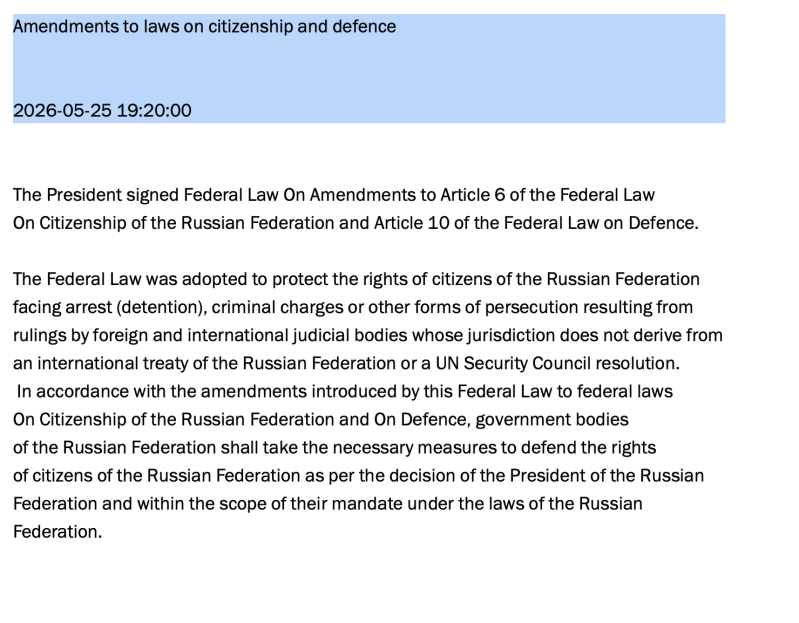
Above findings indicate that in this matter, the European Council holds the legal cards for it has already legally defined and protected the scope of sanctions, including instructions to European courts to consider Russian jurisdiction invalid with regards to property. In a physical sense, the odds may be somewhat different following a bill that has been signed into law by President Putin of Russia on 25 May 2026 (retrieved from en.kremlin.ru, no secure connection). This Federal Law on Amendments to Article 6 of the Federal Law on Citizenship and Article 10 on the Federal Law on Defence gives the President of the Russian Federation a legal mandate to protect the rights of Russian citizens who face prosecution, arrest or other criminal charges and indicates a potential use of force in court proceedings when deemed necessary by the Russian State.
In this case, the parties involved are legal persons, not natural ones. Yet the move is rather unprecedented and reason for cautious attention.
Add comment
Comments